After-hours answering for property management: define who owns each callback
An after-hours answering service for property management needs a named person behind each promised next step. Define who reviews routine tenant, leasing and contractor messages, who covers an unavailable owner, and how the morning team finds unresolved requests. A message recorded overnight does not establish that a manager accepted it, a contractor was assigned or a repair was arranged.
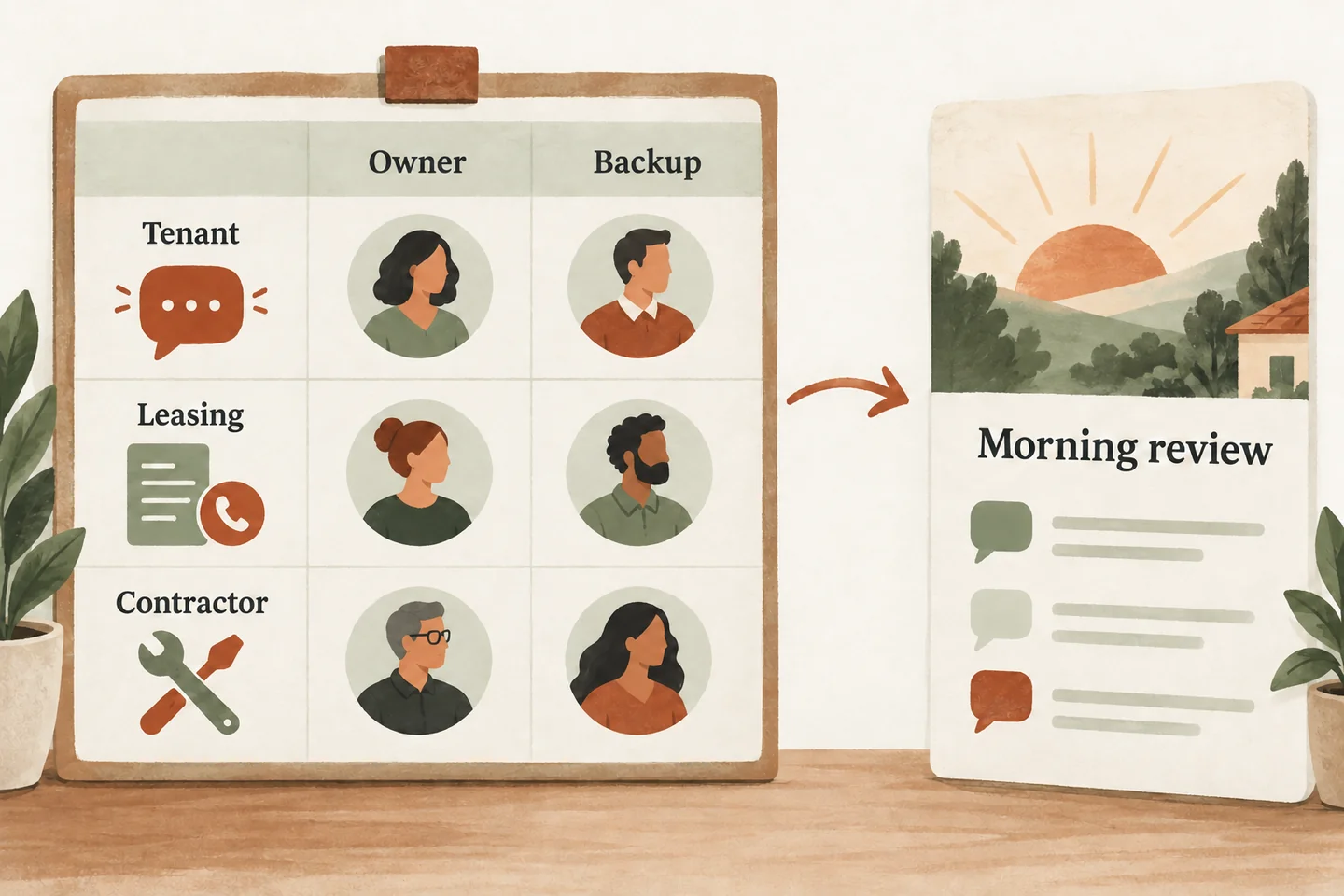
Choose one workflow before assigning overnight responsibility
Start by reviewing the AI receptionist for property management fit questions. As checked October 27, 2026, the current service offer covers one business, one location, one receptionist and one supported calendar. Confirm what that means for the proposed office or property. A management company’s single phone number does not establish support for its entire portfolio.
Write down which routine calls enter this workflow and which remain with existing staff processes. Keep owner-approved urgent-contact instructions separate. The receptionist should not diagnose a reported problem, decide that it can safely wait, or promise emergency dispatch. Human response arrangements need their own review; this worksheet does not establish them.
Use the after-hours coverage checklist to align the office’s published hours with actual staff availability. A closed office can still receive a message; that does not make its team available overnight.
Fill in the owner and backup before routing calls
This original matrix is a planning example for fictional Example Property Office. Replace every role with a named, reachable person and a verified receiving method. Confirm that the chosen person has accepted the responsibility. The rows propose a workflow; they do not describe an installed integration or customer outcome.
| Routine enquiry | Primary owner to name | Backup to name | Morning evidence to check |
|---|---|---|---|
| Tenant administrative question | Property administrator: ______ | Duty manager: ______ | Correct property reference; question and callback details; assigned reviewer. |
| Leasing or viewing enquiry | Leasing coordinator: ______ | Office manager: ______ | Preference recorded; no viewing promised unless a verified booking succeeded. |
| Contractor scheduling question | Maintenance coordinator: ______ | Duty manager: ______ | Caller’s question and job reference; no authorization or attendance promise. |
| Routine maintenance message | Designated property reviewer: ______ | Duty manager: ______ | Caller’s description preserved; staff decide any work order or contractor assignment. |
Add a separate instruction beside each row: when the owner checks it, how a backup is activated, and who verifies that follow-up happened. A shared inbox can be the receiving place, but “the inbox” is not the person responsible. Do not state a callback deadline until the business has approved it and can support it.
Record enough to find the request without collecting access details
Capture the property identifier, relevant unit or location if needed, caller’s name, callback number and short reason for calling. Read back a corrected property reference or phone number. Keep a preferred contact time as a preference rather than converting it into a scheduled callback.
Do not collect door codes, alarm codes, passwords, payment details or identity documents in this routine intake. A unit reference is useful context, not identity verification. Questions about account information, permission to enter or contractor access should follow the business’s approved staff process.
For a contractor call, retain an existing job reference only if supplied and needed. Recording that reference does not validate the contractor, grant access, approve additional work or demonstrate that the receptionist can open the property-management system.
Decide what happens when the named person does not answer
The current AI voice agent workflow supports approved owner or on-call transfer destinations with an agreed unanswered fallback. Somebody still needs to answer. Test the permitted destination and the fallback rather than assuming that a second phone number guarantees contact.
Use the unanswered-transfer fallback dialogue to write the caller-facing explanation. A failed transfer should not sound like successful escalation. Keep the actual result clear: transfer attempted, nobody connected, and a request recorded if that supported step succeeded.
Do not automatically put an owner-approved urgent-contact request into the ordinary morning queue when the recipient is unavailable. The business must provide and test its separate instructions. If that handling is unresolved, keep those calls outside this pilot until the responsible team has an approved route.
Use closing words that match the recorded outcome
Use that wording only after the message was actually captured. If capture fails, explain that it did not complete and use the approved alternative. Replace vague assurances such as “maintenance is on its way” with the action that actually occurred.
Keep a message, a work order and a completed job as different records. Staff may decide that a message needs a work order in their existing system. The call summary alone is not evidence that this later action happened, and a work-order number is not proof that the job is finished.
Test the overnight handoff and the next morning
Run fictional tenant, leasing and contractor calls before activation. Include an incorrect property reference, an unavailable primary owner, an unavailable backup and a caller requesting a response time that nobody has approved. Check what was said and what the responsible person can actually retrieve.
At the next opening, have the named reviewer reconcile each test message: assigned owner, needed action, any attempted contact and what remains unresolved. Confirm that another staff member can identify the outstanding request without guessing. Review duplicates together without deleting context or assuming two similar callers describe the same matter.
Bring that evidence to the answering-service evaluation checklist. Then try the live AI receptionist demo with fictional, nonsensitive details. It opens configuration and requires you to press Start. The sample does not prove a property-system connection. Request a personal demo to review the exact supported workflow before paid activation.
Sources and further reading
YOUR CALLS, YOUR NEXT STEP
Test who owns the next callback

Try a fictional property-office enquiry, then request a personal demo to verify the receiving method, staff availability and agreed fallback for your narrow workflow.