Pest control answering service: capture inspection requests with clear boundaries
A pest control answering service can help prepare an inspection request by recording what the caller noticed, where the property is and who should follow up. The useful outcome is an accurate handoff. It is not a pest identification, treatment recommendation or promise that a technician will attend. Separate new enquiries from existing-customer questions before deciding which information to collect.
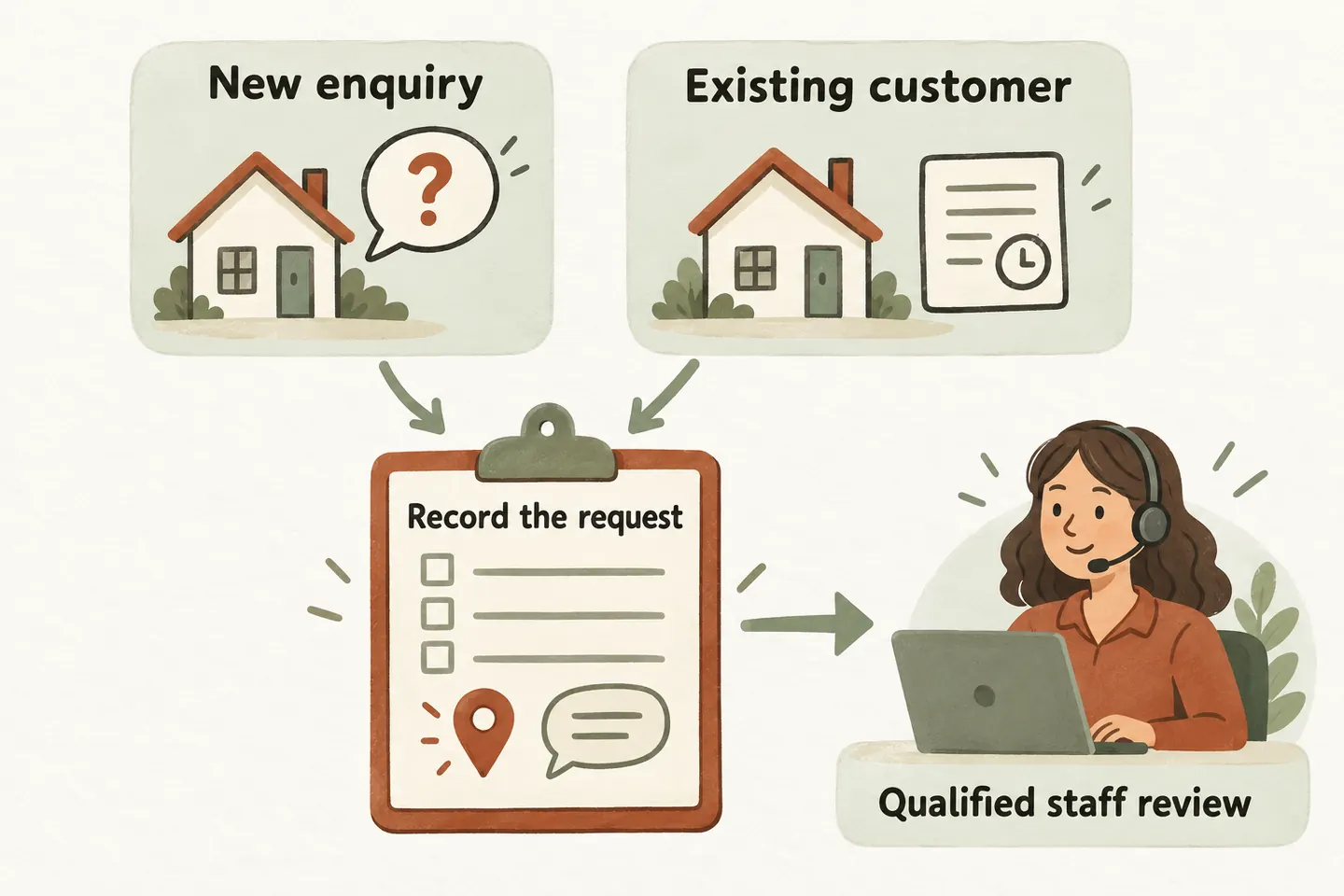
Record observations without naming the problem
Start with an owner-approved service list and a plain question: “Are you asking about a new inspection, or following up on service you already received?” If the answer is unclear, keep that uncertainty in the record. Do not label someone as a confirmed customer merely because they say they have called before.
Ask what the caller noticed and where they noticed it. Preserve their wording. “Small insects near the kitchen window” is a reported observation; it does not become an identified species or a treatment category. Do not ask callers to handle anything, investigate an unsafe area or collect a sample for this intake.
Use a nontechnical inspection-request form
This original form is a planning worksheet, not a claim that every field or routing rule is already configured. Adapt it to the business’s approved process. Collect only details needed to review the request; leave unknown answers marked unknown.
| Field | Ask or record | Keep this boundary |
|---|---|---|
| Enquiry type | New inspection request, existing-service follow-up or unclear. | Reported customer status is not verified identity. |
| Caller and callback | Name, callback number and preferred contact window; read back the number. | A preferred window is not a callback guarantee. |
| Property location | Service address, unit if relevant and whether the caller is an owner, tenant or manager. | Location and caller role do not establish permission to enter. |
| Caller observation | Their description, where it was noticed and when they noticed it. | Do not identify the pest or infer severity. |
| Request or prior visit | Desired inspection timing; for follow-up, a visit date or reference if known. | Do not confirm a warranty, repeat treatment or appointment from this alone. |
| Human handoff | Named reviewing role, unresolved questions and the next step explained. | Use approved routing; no automatic dispatch or promised arrival. |
For uncertain addresses, use the service-area eligibility worksheet. Do not turn a nearby location into an accepted job. Avoid access codes, payment details and medical histories. A caller’s request to change an existing visit should remain pending until the authorized process confirms the change.
Keep new inspections and follow-up separate
Consider two fictional enquiries for an imaginary company, Maple Lantern Pest Services. A new caller reports insects beside a window and asks for Friday afternoon. Record the observation, property details and preferred time. The inspection reviewer still decides whether the business accepts the request and whether a suitable appointment is available.
An existing-customer caller says activity continued after last week’s visit. Record the caller’s description and the visit reference they provide, then route it to the approved follow-up owner. Do not decide that treatment failed, promise a free return visit or disclose account information. Staff must verify the relevant record and explain the next step.
If someone asks both for a new inspection and about an earlier service, preserve both issues. A sales request must not erase an unresolved follow-up. These examples illustrate recordkeeping choices, not actual customer outcomes.
Hand technical and exposure questions to qualified people
Health Canada’s pesticide safety guidance stresses correct pest identification and suggests considering a licensed professional. This supports a clear editorial boundary: an intake conversation should not improvise identification, product selection or treatment advice.
An editable response is: “I can record your question for the qualified team, but I cannot identify the pest or advise on treatment.” Do not answer questions about mixing products, re-entry times or whether a person or animal is safe. Do not imply the voice service can assess exposure.
Exposure concerns must not wait in an ordinary inspection callback queue. Before activation, have qualified staff approve the appropriate safety wording and escalation procedure for the jurisdictions served. Test that boundary separately. Routine request capture is not an emergency-response service.
Check the actual answering and booking scope
When you design an AI receptionist call flow, give inspection requests and existing-service questions an owner and an unanswered-transfer fallback. Check what the caller hears when that person is unavailable. Answering a phone does not make the business’s qualified staff immediately available.
Our public offer, checked October 21, 2026, covers approved business information, request capture and configured handoffs. Google Calendar booking needs an enabled workflow, a connected calendar and a successful save before confirmation. A requested inspection time remains a preference until then. Even a saved inspection appointment does not authorize treatment or establish a technical finding.
Review how the AI voice agent handles calls against your workflow. The current scope is one business, one location, one receptionist and one supported calendar. Do not assume pest-management software integration, treatment-history access, technician dispatch or multi-crew scheduling from a sample demonstration.
Test the handoff before forwarding calls
- Use a fictional new enquiry with an uncertain address and preferred date. Confirm that uncertainty survives in the request and no visit is promised.
- Use a fictional follow-up that asks for a free return visit. Check that the response preserves the question without granting coverage or changing a service record.
- Ask an identification or treatment question, then make the reviewing person unavailable. Check the approved boundary and fallback rather than accepting an invented answer.
Compare each resulting record with what the caller heard. Can the assigned reviewer identify the enquiry, reach the caller and see what remains undecided? Correct missing or misleading details and repeat the affected test. You can try the live AI receptionist demo using fictional, nonsensitive details; request a personal demonstration to verify your own intake rules before paid production activation.
Sources and further reading
YOUR CALLS, YOUR NEXT STEP
Test a fictional inspection enquiry.

Explore the live demo without real customer, property or health information. Request a personal demo to review your approved intake, staff handoff and booking requirements.