Estimate the value of missed business calls without guessing revenue
A missed call cost calculator for a small business should estimate a range, not multiply every unanswered ring by an average sale. Count unique, relevant enquiries, remove work already recovered through callbacks, and model how many additional jobs might actually be completed. Then use contribution after variable job costs to compare a limited coverage test with its cost. The worksheet below keeps observed facts separate from assumptions.
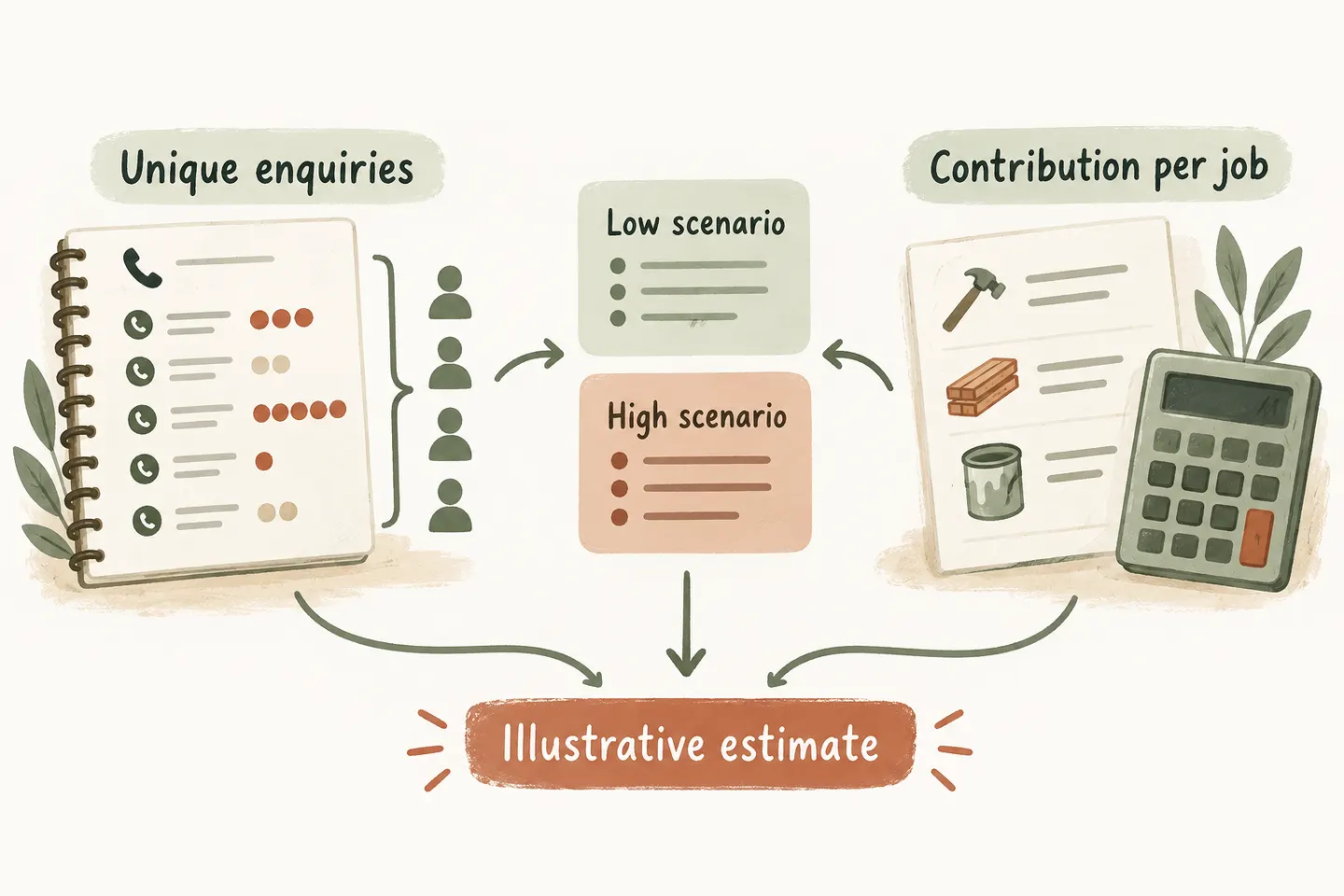
Separate missed calls from unique prospective customers
Choose a defined period and coverage window, such as unanswered calls during lunch over four weeks. Record the dates, opening hours and any unusual closure. A month containing a storm, promotion or holiday may not represent ordinary demand. Keep that context beside the numbers rather than silently projecting it across the year.
Review repeat attempts before counting opportunities. Three calls about one quote are one enquiry, while an existing customer asking about an invoice is a different workflow from a new sale. Separate suppliers, wrong numbers, spam and people outside your service area. Keep unknown callers in an unknown category; do not automatically classify them as qualified leads.
For an AI receptionist for small business, this distinction helps define the task being evaluated. Approved information, request capture and a clear callback owner may matter even when a call produces no new sale. Evaluate those service outcomes separately from the financial model.
Use a sample of real call outcomes
Review business records you are authorized to use. Use anonymous enquiry references in the worksheet, not copied names, phone numbers or private conversation details. Follow each relevant enquiry far enough to distinguish a callback, a quote, an accepted job and completed work. A sent quote is not a completed sale.
| Field | Your evidence or assumption |
|---|---|
| Coverage window | [Dates, hours and unusual demand conditions] |
| Raw missed attempts | [Count from the call log] |
| Unique prospective enquiries | [Remove duplicate attempts and unrelated calls] |
| Qualified enquiries | [Requests matching your service area and work scope] |
| Already recovered | [Relevant enquiries that became completed jobs through existing follow-up] |
| Unresolved qualified enquiries, U | [Qualified minus already recovered; track unknown outcomes separately] |
| Additional completion assumption, p | [Low and high scenarios, with a written reason] |
| Contribution per completed job, C | [Job revenue less variable job costs, in one currency] |
| Total test cost, T | [Coverage charge plus incremental review, administration and other test costs] |
Keep the date of the outcome review. If jobs usually take weeks to complete, a short observation window can make successful enquiries look unresolved. Revisit the same group later instead of adding its repeat calls to another month’s total.
Model low and high conversion assumptions explicitly
The simplest planning expression is U × p × C. Here, p means the assumed proportion of unresolved qualified enquiries that an improved process would turn into additional completed jobs beyond your existing process. It is not a vendor’s general booking rate, and it is not the percentage of all calls answered.
Write why each assumption could be wrong. Some callers may have chosen another provider, need unavailable work or never respond. Capacity can also prevent additional jobs. Keep a zero-additional-jobs downside case, and do not describe the high scenario as recoverable revenue. A small sample supports a cautious test, not a confident annual forecast.
Calculate contribution rather than equating quote value with revenue
Use the contribution-margin distinction explained by OpenStax: sales less variable costs. For this worksheet, estimate contribution per completed job after the costs that change when that job is performed, such as materials and applicable variable labour. Check cost classifications with your bookkeeper when the distinction is unclear.
Continuing the fictional example, assume each completed job produces US$500 in revenue and US$320 in variable costs: C = US$180. The low case is 9 × 0.10 × US$180 = US$162. The high case is 9 × 0.30 × US$180 = US$486. These are modeled contributions before coverage-test costs and fixed overhead, not net profit or customer results.
If the same-period test costs a hypothetical US$200 in total, subtract that once: the modeled result is minus US$38 to plus US$286 before fixed overhead. At US$180 contribution per job, two actual additional completed jobs would exceed that test cost. This arithmetic does not establish that either job will occur.
Use separate rows for materially different job types instead of letting one unusually large project set the average. Keep currencies consistent and never compare a monthly service cost with an annual contribution estimate.
Use the result to set a test budget
Choose an affordable, bounded test even if the modeled outcome is zero. Define the covered hours, responsible reviewer, spending limit and evaluation date. Include the time needed to review requests and follow up. A promising high scenario does not justify a commitment that the business cannot comfortably fund.
Before estimating a service allowance, estimate monthly call minutes. Count the conversations the workflow would handle, including calls that are not new sales. Review current prices and billing scope separately; this worksheet is not a quote or a plan recommendation.
Test the AI receptionist call flow for useful intake and reliable handoffs. Compare completed outcomes with your previous process while noting changes in demand, staffing and capacity. A before-and-after difference alone does not prove the receptionist caused it.
You can try the live AI receptionist demo using a fictional, nonsensitive enquiry. The homepage setup opens first; press Start when ready. The sample is not a revenue test or a real booking. Request a personal demo to review your proposed coverage and actual workflow before paid activation.
Sources and further reading
YOUR CALLS, YOUR NEXT STEP
Test the call experience before setting a coverage budget

Use a fictional enquiry in the live demo, then request a personal demonstration to review scope, follow-up ownership and the evidence you will measure.