Estimate monthly call minutes from a small sample of your call log
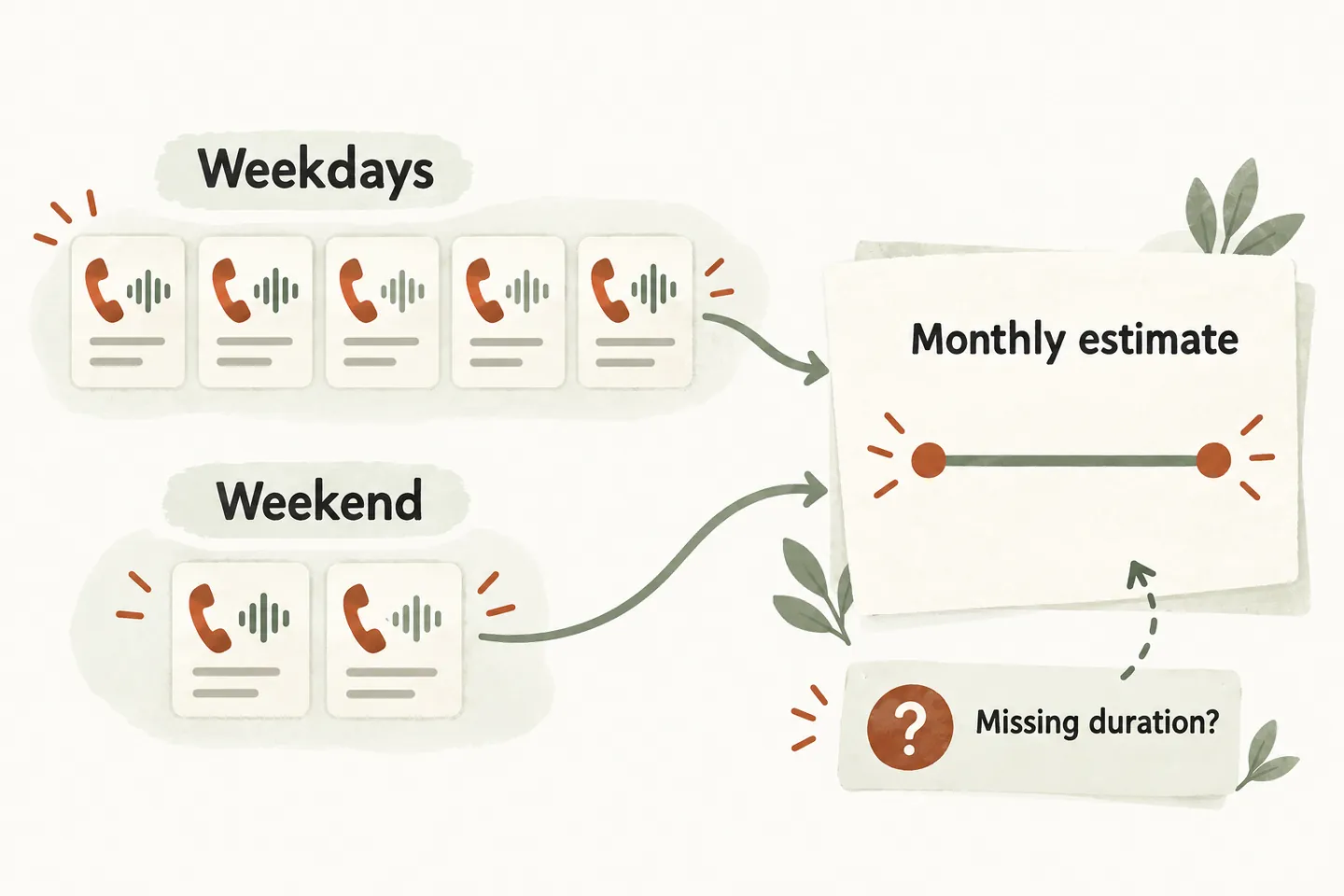
An AI receptionist minutes calculator needs a defined call scope and usable duration records. Start with seven days, separate weekdays from weekends, and scale each group to the month you are planning. Treat the result as a conversation-time estimate, then check how the provider counts billable usage. A short sample cannot establish a guaranteed monthly bill.
Choose which calls the estimate covers
Decide whether you are estimating all incoming calls, after-hours calls or one overflow window. For an AI receptionist for small business, count the calls expected to reach that configured workflow. Do not project the entire phone line when only lunch coverage is proposed.
Write down the route, covered hours, sample dates and exclusions. Keep spam, unanswered calls and test calls identifiable rather than silently deleting them. Your provider may count some activity differently from this worksheet; an operational forecast and a billing calculation are separate tasks.
Fill a seven-day call-log worksheet
Use records from your existing phone provider where available. Distinguish connected conversation duration from ringing or total session duration when the record permits. If the field is ambiguous, ask what it measures. Do not subtract guessed ringing time or assume transferred call segments are counted only once.
The following complete sample is fictional. Every listed connected call has a known duration; the zeroes indicate no missing-duration calls, not no demand. Times are minutes, not decimal hours. Keep source references and routing notes alongside your own copy, without copying caller details into a shared planning sheet.
| Day | Connected calls | Known minutes | Unknown-duration calls |
|---|---|---|---|
| Monday | 8 | 24 | 0 |
| Tuesday | 10 | 30 | 0 |
| Wednesday | 6 | 18 | 0 |
| Thursday | 9 | 27 | 0 |
| Friday | 7 | 21 | 0 |
| Saturday | 4 | 12 | 0 |
| Sunday | 2 | 6 | 0 |
Retain the original duration units. Convert seconds to minutes by dividing by 60 before totaling; 90 seconds is 1.5 minutes, not 0.90 minutes. Keep unrounded totals for planning. Ask separately whether the service rounds billable time per call.
Project weekdays and weekends separately
In the sample, five weekdays contain 40 calls and 120 minutes: 24 minutes per weekday. The two weekend days contain six calls and 18 minutes: nine minutes per weekend day. Pooling all seven days would hide that difference.
For a hypothetical 30-day month containing 22 weekdays and eight weekend days, calculate (24 × 22) + (9 × 8) = 600 minutes. The matching call projection is (8 × 22) + (3 × 8) = 200 calls. Both calculations describe this example, not typical business demand.
Count the actual days in your target month. If Saturday and Sunday differ meaningfully, calculate them separately. Treat a planned closure as its own assumption: a closed office might still receive calls, depending on the answering route.
Show gaps instead of treating them as zero
A connected call with an unknown duration is missing information. Record it in the unknown column and try to recover the duration before projecting. A zero-minute entry should represent a verified zero under the record definition, not a blank you filled to finish the sheet.
Existing call lengths may change under a new answering workflow. Calls currently unanswered have no baseline conversation duration. If the new route will answer them, keep them in scope as a separate call count with an explicitly assumed duration, then test that assumption.
If gaps remain, report the known-minute subtotal and missing-call count. You may model assumed durations separately, but label the assumption and show its effect. Do not present an incomplete total as a complete measured week. If most durations are missing, collect a better sample before selecting an allowance.
Build a range with explicit seasonal assumptions
A single week may coincide with a promotion, weather event or unusually quiet period. Review older comparable records if you have them. When evidence is limited, use scenarios to expose uncertainty rather than pretending a multiplier is a measured trend.
| Scenario | Explicit assumption | Estimated minutes |
|---|---|---|
| Lower demand | 20% fewer calls; duration mix unchanged | 600 × 0.8 = 480 |
| Sample pattern | Same weekday/weekend pattern and durations | 600 × 1.0 = 600 |
| Busier period | 40% more calls; duration mix unchanged | 600 × 1.4 = 840 |
These percentages are invented planning assumptions, not a confidence interval or expected seasonal uplift. Replace them with justified inputs. If busy-period calls also take longer, change both call volume and duration; do not claim the table already accounts for that.
Compare allowances after confirming billing rules
As checked October 20, 2026, you can compare the current USD plans with these published monthly allowances, before applicable tax:
| Plan | Monthly USD price | Included call minutes |
|---|---|---|
| Starter | US$99 | 100 |
| Growth | US$249 | 450 |
| Business | US$497 | 1,000 |
The fictional 480–840-minute range exceeds 450 and stays below 1,000 conversation minutes. That arithmetic does not establish billable usage or make a plan recommendation. Confirm rounding, counted activities and transfer handling first. The public offer says usage limits and additional charges are agreed before activation; extra minutes and automatic overage charges are not enabled by default.
Messaging is excluded. The standard scope is one business, one location, one receptionist and one supported calendar. Do not invent an overage rate, convert the listed price into a promised Canadian-dollar charge or assume unused allowance rolls forward.
Review the estimate against actual use
Keep your source week, formulas, missing-data notes and assumptions together. Use the same forecast in an AI receptionist vs answering service comparison, including remaining staff work. After activation, compare actual usage with the forecast and discuss changes before relying on a larger allowance.
You can try the live AI receptionist demo with a fictional enquiry. A sample conversation can help you consider the questions callers need answered; it cannot measure your future call volume or establish billing terms. Request a personal demonstration to review the proposed scope before paid activation.
Sources and further reading
YOUR CALLS, YOUR NEXT STEP
Explore the call experience, then review your allowance

Try the live demo with fictional details. For your own call scope and estimated minutes, request a personal demo and confirm usage terms before paid activation.