AI receptionist vs voicemail: which missed-call workflow fits?
The AI receptionist vs voicemail decision depends on what must happen before staff return a call. Voicemail may be sufficient when callers leave usable messages and someone reviews them consistently. Guided intake is worth testing when missing details or a permitted action make a conversation useful. Neither approach replaces staff ownership or proves that a caller’s request has been completed.
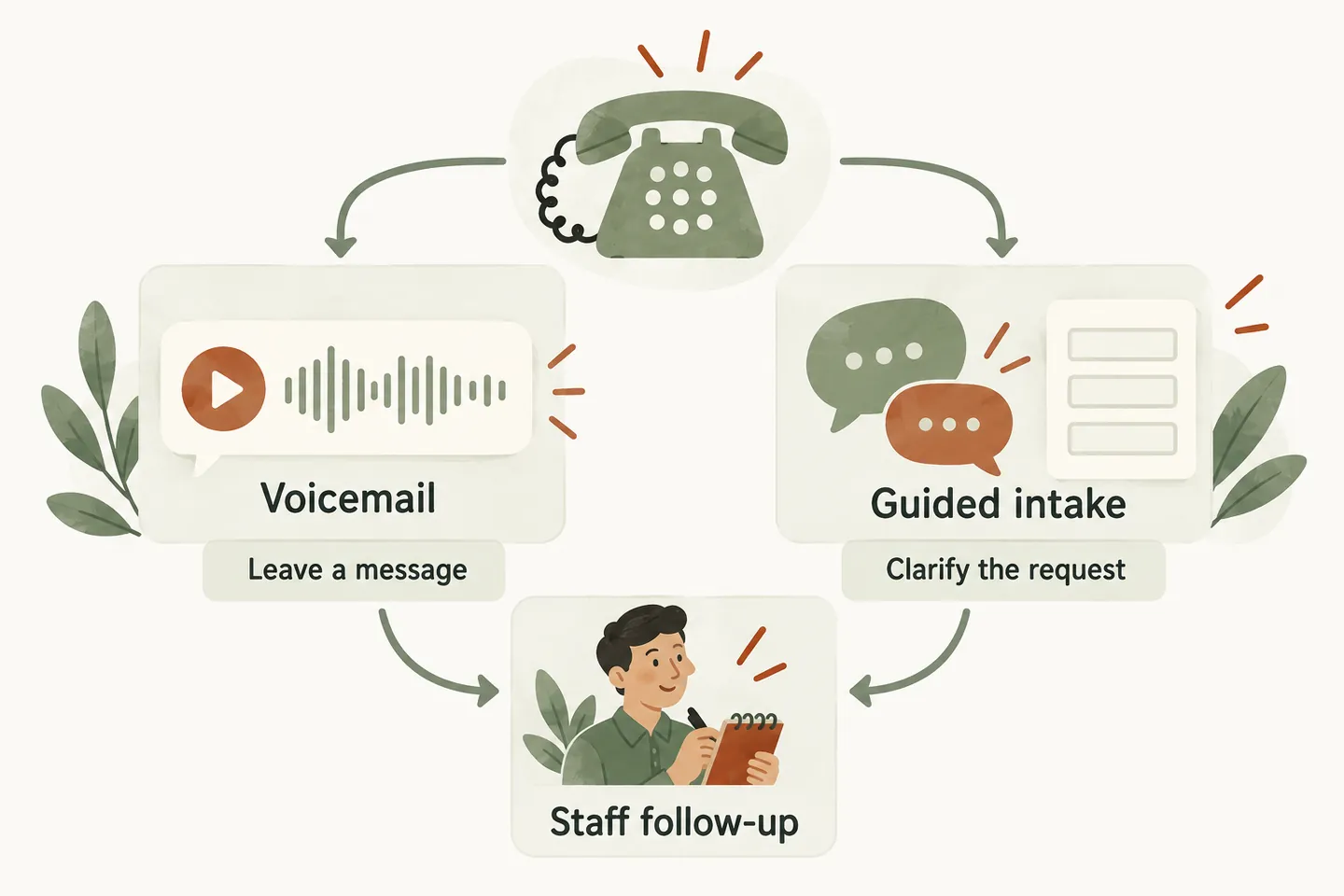
Define what makes a message ready for a callback
Before comparing tools, write the minimum record your team needs: caller name, usable callback number, reason for calling and any detail needed to identify the request. A service location may matter for a visit; it may be unnecessary for a general opening-hours question. Collect only what serves the next step.
Define the outcome too. “Requested Tuesday” and “Tuesday appointment saved” mean different things. Your AI receptionist call flow should show which outcomes are permitted and who handles unfinished work. This guide compares a message left for later with a guided conversation, rather than comparing AI with a human answering provider.
Where voicemail can be enough
A conventional voicemail greeting asks the caller to leave a message for later review. It can be a workable choice when requests are straightforward, callers usually provide the needed details and the team keeps its stated review process. Fix an unclear greeting or neglected inbox before assuming a different tool will solve the problem.
Voicemail does not necessarily mean audio-only administration. Google Voice’s product page describes automatic voicemail transcription. Check your own provider’s features and plan rather than treating every voicemail system as identical. Reading a transcript can help review a message; it does not itself establish that a business action happened.
Use your existing records to identify the actual difficulty: unread messages, missing numbers, uncertain service scope or requests that require clarification. A new interface will not assign responsibility unless you do.
Follow this missed-call decision tree
Start at question one. A clear voicemail fit ends the decision there; otherwise follow the next question. This is an original planning aid, not a claim that one option always performs better.
| Question | If yes | If no |
|---|---|---|
| 1. Do existing messages contain enough information for the agreed callback process? | Keep voicemail and maintain the review routine. | Go to question 2. |
| 2. Can approved follow-up questions resolve the missing details? | Go to question 3. | Improve the greeting or staff process first. |
| 3. Does this workflow need a booking or transfer during the call? | Verify that exact action and its failure path, then go to question 4. | Go to question 4 with request-only scope. |
| 4. Is someone responsible for requests and exceptions? | Test the defined guided-intake scope. | Assign an owner before changing the workflow. |
A caller’s question may still need human judgment. Keep that path separate from routine intake instead of expanding the script until it seems able to handle everything.
What a guided conversation can add
A configured AI receptionist for small business can ask follow-up questions and use approved information. For example, a fictional caller says, “Please call me about a visit.” A useful test is whether the conversation captures the service requested, callback number and relevant location, then accurately labels the result as a request.
The benefit to evaluate is clarification, not simply a longer conversation. Check whether a corrected number survives in the final record and whether the agent avoids repeating questions the caller already answered. AI can misunderstand or produce an incorrect answer, so compare the resulting record with what the caller actually said.
Keep unsupported prices, service exceptions and sensitive decisions with authorized staff. Do not assume a conversational response creates a quote, dispatch instruction or guaranteed callback time.
Check unavailable bookings and unanswered transfers
Our current public offer supports booking when the workflow is enabled and Google Calendar is connected. An appointment is confirmed only after it saves successfully. If a suitable time is unavailable or saving fails, the caller should hear that the preference remains a request for staff review.
Transfers use an approved owner or on-call destination with an agreed unanswered fallback. A configured destination is not proof that someone is available. Test an unanswered attempt and inspect its recorded outcome. Neither a captured request nor a transfer attempt promises a technician’s arrival or provides emergency dispatch.
If these actions are unnecessary for your first comparison, leave them outside the experiment. A request-only scope makes it easier to judge whether guided intake improves the information your team receives.
Run one limited overflow experiment
Use a single recurring lunch window for routine service enquiries. This hypothetical experiment has no assumed results. Follow the lunch-break overflow checklist to agree routing, a staff owner and a fallback before starting.
- Baseline: review voicemail across five selected lunch windows. Record routed calls, usable requests, incomplete messages and staff review time.
- Trial: after setup approval, use request-only guided intake across five comparable windows on the same weekdays and hours. Keep the required fields and review owner unchanged.
- Control scope: confirm carrier compatibility, forwarding terms, usage allowance and the route for returning to the previous setup. Test with fictional calls before routing customers.
- Measure: divide usable request records by non-spam calls routed into each workflow. Include no-message or unclassified calls unless evidence justifies exclusion; show the raw counts alongside the rate. With no qualifying calls, record no data.
- Review: count a record as usable only when required details and outcome status are accurate. Track false commitments and staff effort separately; an improved rate does not excuse an unsafe or misleading response.
A small comparison is operational evidence, not proof of a general conversion lift. Note differences in demand and call types. Stop and correct failed boundaries; keep voicemail if it serves the task without unnecessary extra work.
Choose the workflow from observed results
Decide whether the missing information was solved, whether staff could act and whether the effort and terms fit your business. Keep the same callback ownership whichever route you choose. Changing how calls are received does not guarantee more leads or faster follow-up.
You can try the live AI receptionist demo with a fictional enquiry, then request a personal demonstration for your proposed workflow. The website sample does not handle real customer calls or create real appointments. Production service requires approved configuration, setup checks and paid activation.
Sources and further reading
YOUR CALLS, YOUR NEXT STEP
Test the information your next callback needs.

Try a fictional enquiry, then request a personal demo to check the approved questions, request record and fallback for one missed-call workflow.