Weekend answering service: set a callback policy your team can keep
A weekend answering service can capture a request while your team is away. Your callback policy should say who owns that request, when someone checks it and what the caller may reasonably expect. Keep a preferred callback time separate from a commitment, and replace vague promises about “Monday” with the actual reopening date and timezone.
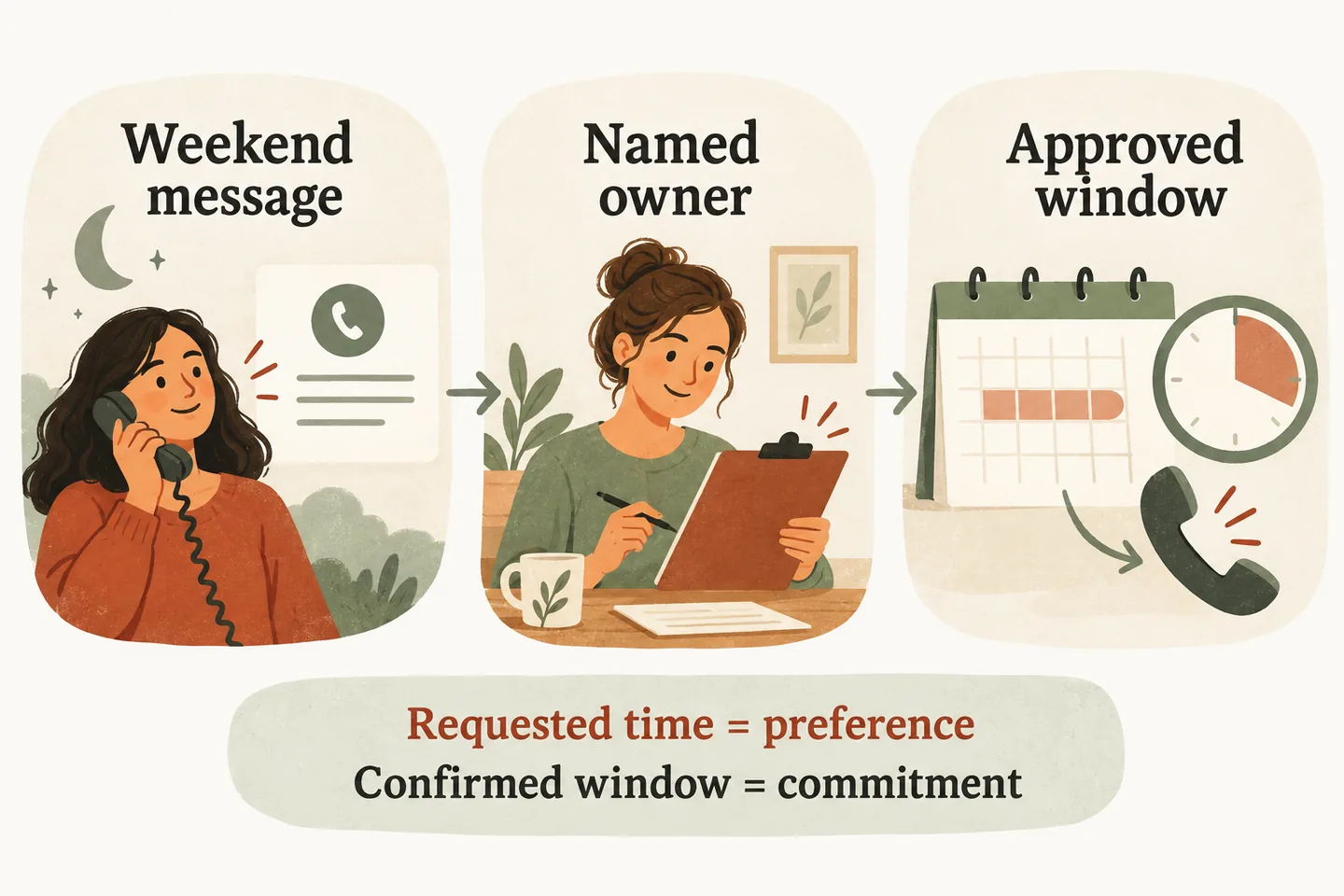
Give each overnight message a human owner
Start with the after hours answering service coverage plan, then write the narrower promise policy. A recorded message, a staff review and a completed conversation are different outcomes. Someone must check that each request moves between them; saying “the team” leaves that responsibility unclear.
The current AI receptionist for small business offer includes callback-request capture and approved human transfers with an agreed fallback. Those features do not establish a callback deadline. Name a primary reviewer and an available backup. If neither can accept responsibility, change the approved wording before the closure rather than promising an unattended response.
Copy this callback-policy template
This is a fictional operating policy for Example Service Company, not a configured product feature or a customer result. Replace every example with an arrangement your staff have accepted. The reviewer checks requests; the callback owner makes contact or records why the request remains open.
| Policy field | Fictional example | Your approved entry |
|---|---|---|
| Business days and timezone | Monday–Friday, 09:00–17:00, America/Toronto. Dated closures override these hours. | [Days, hours, timezone, closure dates] |
| Review owner and backup | Office lead reviews; duty manager accepts responsibility if the lead is absent. | [Named people and availability] |
| Business-day cutoff | Requests received before 16:00 enter the same-day review; requests at or after 16:00 enter the next open-day review. | [Cutoff and feasible review target] |
| Reopening review target | Office lead checks weekend messages at 09:30 on the next open day. This is an internal target. | [Actual reviewer and review time] |
| Caller preference | Record preferred date, reachable time range and timezone; label these as requested. | [Questions to ask and wording] |
| Commitment authority | A responsible staff member confirms a callback window only after checking availability. | [Who can approve and how recorded] |
| Unfinished follow-up | Keep unanswered attempts open with an owner and next review time. | [Owner, next check and closure rule] |
Keep the approved wording beside this policy. Assign a review date before each planned closure. If responsibilities change, check the supported update process and preview the revised wording before relying on it.
Translate cutoffs and closures into actual dates
In the example, a Thursday request received at 15:50 belongs in Thursday’s review; one received at 16:10 belongs in Friday’s. Neither rule promises when a person will telephone. Decide which timestamp establishes receipt, and use the business timezone consistently when checking the cutoff.
Suppose this fictional business is closed on Monday, October 26, 2026, for a planned office closure. Its next opening after the preceding weekend is Tuesday, October 27, at 09:00 Toronto time. This is an invented business exception, not a statement about a statutory holiday. Replace the normal Monday message with that exact reopening information.
Use three truthful caller responses
These hypothetical responses use the example policy. Adapt the dates and availability before use, and acknowledge receipt only when the request has actually been captured.
None of these responses converts an urgent request into emergency dispatch. Use the business-approved safety boundary; do not diagnose a problem or promise a technician’s arrival.
Record a reachable window without creating a promise
Ask for a usable date and time range, including the caller’s timezone. Repeat it back as a preference: “You prefer Tuesday between 10 and noon, Vancouver time.” Avoid an unqualified “Tuesday works.” If the preferred window has passed before review, the owner needs a new arrangement rather than silently treating the old request as agreed.
The AI voice agent guide explains that a transfer depends on someone being available. Apply the same honesty to follow-up. A captured request is not an automatic outbound call, and a review target is not a guaranteed response. Verify the practical handoff with the setup team.
Check missed follow-ups with a small exception log
Keep this review focused on promises and ownership. Use a request reference instead of copying unnecessary personal details into a separate sheet. The following entries are fictional.
| Reference | Observed outcome | Responsible next step |
|---|---|---|
| Example W01 | Preferred window passed before review. | Office lead records this and arranges another contact opportunity. |
| Example W02 | Staff called; nobody answered. | Callback owner records the attempt and the next check; request stays open. |
| [Reference] | [What actually happened] | [Named owner and next review time] |
At reopening, compare the wording callers heard with what staff could deliver. Revise an unworkable cutoff or review target rather than repeatedly leaving the same expectation unmet.
Test the wording before the next weekend
Use a fictional, nonsensitive request to try the live AI receptionist demo. Listen for the distinction between a request and a commitment. Then review your own cutoff, closure exception and unanswered-transfer wording in a personal setup discussion. The website sample does not demonstrate your production policy or promise a real callback.
Sources and further reading
YOUR CALLS, YOUR NEXT STEP
Hear how a callback request sounds

Try a fictional, nonsensitive call, then request a personal demo to review your team’s actual availability, closure wording and handoff responsibilities.