Roll out an AI receptionist in stages: overflow, after hours, then wider coverage
Start an AI receptionist rollout with one limited call segment, approved answers and a named person reviewing what happened. Expand only after the required outcomes have been observed and unresolved failures have been addressed. Overflow during staffed hours, then selected after-hours coverage, then wider routing is one possible sequence. Each stage needs an entry decision, an acceptance record and a tested way to restore the previous call route.
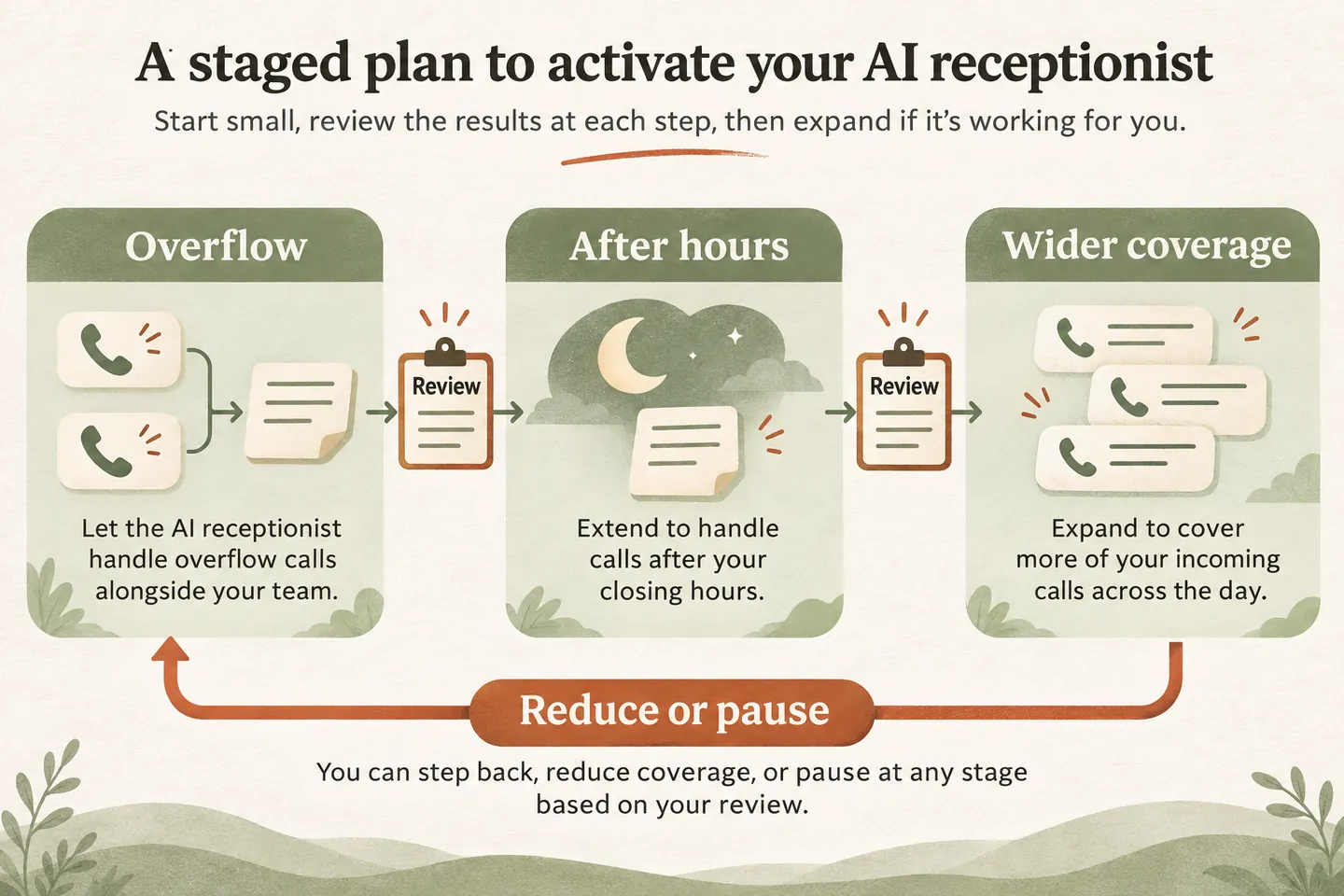
Choose a first segment your team can supervise
Write down which calls enter the pilot and which continue through the existing route. A small plumbing business might begin with unanswered routine enquiries while its office is staffed. The office can review captured requests and answer follow-up questions. This is an illustrative choice, not a recommendation to route every plumbing call or an assurance that the carrier supports a particular forwarding mode.
An AI receptionist for small business can be configured around selected incoming calls. Our current offer describes missed, overflow, after-hours and all-call coverage, with carrier setup checks. Decide the boundaries before selecting the route: approved questions and message capture may be enough for the first stage. Booking and transfers need their own working rules.
Keep staff informed about the start time, covered line and intended caller experience. A pilot that nobody is responsible for reviewing is missing a necessary part of the plan.
Approve the facts and fallback before activation
Use the AI receptionist setup checklist to prepare the business information. This rollout plan adds a different decision: whether the current configuration is ready for a particular slice of live traffic. Record the approved version, permitted actions, review owner and person authorized to reduce coverage.
- Facts: services, hours and exclusions have an identified approver and current source.
- Human fallback: requests reach a named person, with truthful wording when nobody is available.
- Routing: the carrier-specific change and restoration steps have been checked by an authorized account holder.
- Commercial scope: the selected allowance, limit response and any added work have written approval.
Resolve the answering-service extra-charge questions before increasing routed traffic. A small initial route does not establish what a larger one will cost. Production service also requires the approved configuration, setup checks and paid activation; a website demonstration does not complete those steps.
Copy this staged activation card
Add your business, line, owner, review date and configuration version above this table. Replace the example conditions with approved ones. A calendar date is a review appointment, not automatic permission to advance.
| Stage | Entry conditions | Evidence before expansion | If the stage fails |
|---|---|---|---|
| 1. Staffed overflow | Approved routine answers; message owner available; tested route | Requests reach the owner with usable contact details; unknowns remain requests | Restore the previous route and correct the specific failure |
| 2. Selected after hours | Stage-one issues resolved; reopening wording and callback ownership approved | Closed-hours messages give the approved expectation and reach the next reviewer | Return to the last accepted coverage period |
| 3. Wider coverage | Added hours and workload reviewed; each new action separately approved | Representative added cases meet the written rules; review capacity remains adequate | Remove the added scope or restore prior routing |
Record a decision beside every row: proceed, remain at this stage, or reduce coverage. Include who decided, what evidence they reviewed, unresolved items and the next review date. These are operational decisions, not a universal success-rate benchmark.
Judge the completed outcome, not just the conversation
Define acceptance in observable terms. Did the final request contain the corrected callback number? Did the intended person receive it? Did the agent avoid inventing an answer? If booking is included, was the appointment saved successfully under the configured rules? If transfers are included, what happened when the destination did not answer?
Use the repeatable AI receptionist demo test script for fictional rehearsal. Then distinguish sample behaviour from checks of your approved production configuration. Our website demo uses sample actions; it cannot prove your real calendar or telephone route works. Do not label an untested outcome as passed.
Review failed cases individually. Separate inaccurate business information, ambiguous instructions, routing failures and unavailable staff so the next action addresses the cause. A few rehearsals cannot establish performance across every caller, accent, interruption or unusual request.
Keep a usable route back
Before activating a stage, name the person who can restore the previous route and where its instructions are kept. Record the number or existing answering arrangement that should receive calls afterward. Verify what callers hear after the change, and assign someone to reconcile messages already captured. Reducing coverage must not leave those requests without an owner.
Agree on specific stop conditions, such as unsupported promises, missing messages or an unusable fallback. The NIST AI RMF Playbook’s Manage guidance supports documented risk responses and monitoring after deployment. The card here is our practical planning example, not a NIST certification or a guarantee of reliability.
Expand one reviewed change at a time
When the reviewer approves the next stage, record exactly what changes: coverage hours, call category or permitted action. Adding booking is different from extending message capture into the evening. Recheck the relevant rule and fallback instead of treating earlier acceptance as approval for every future capability.
You can try the live AI receptionist demo with a fictional, nonsensitive enquiry. It opens configuration first; press Start when ready. Bring the activation card to a personal demo to verify the proposed route, enabled actions and review responsibilities before real calls begin.
Sources and further reading
YOUR CALLS, YOUR NEXT STEP
Bring one proposed coverage stage to your personal demo

Try a fictional enquiry in the live demo, then discuss the first call segment, acceptance evidence and restoration plan for your business.