Test a plumbing answering service with five realistic caller scenarios
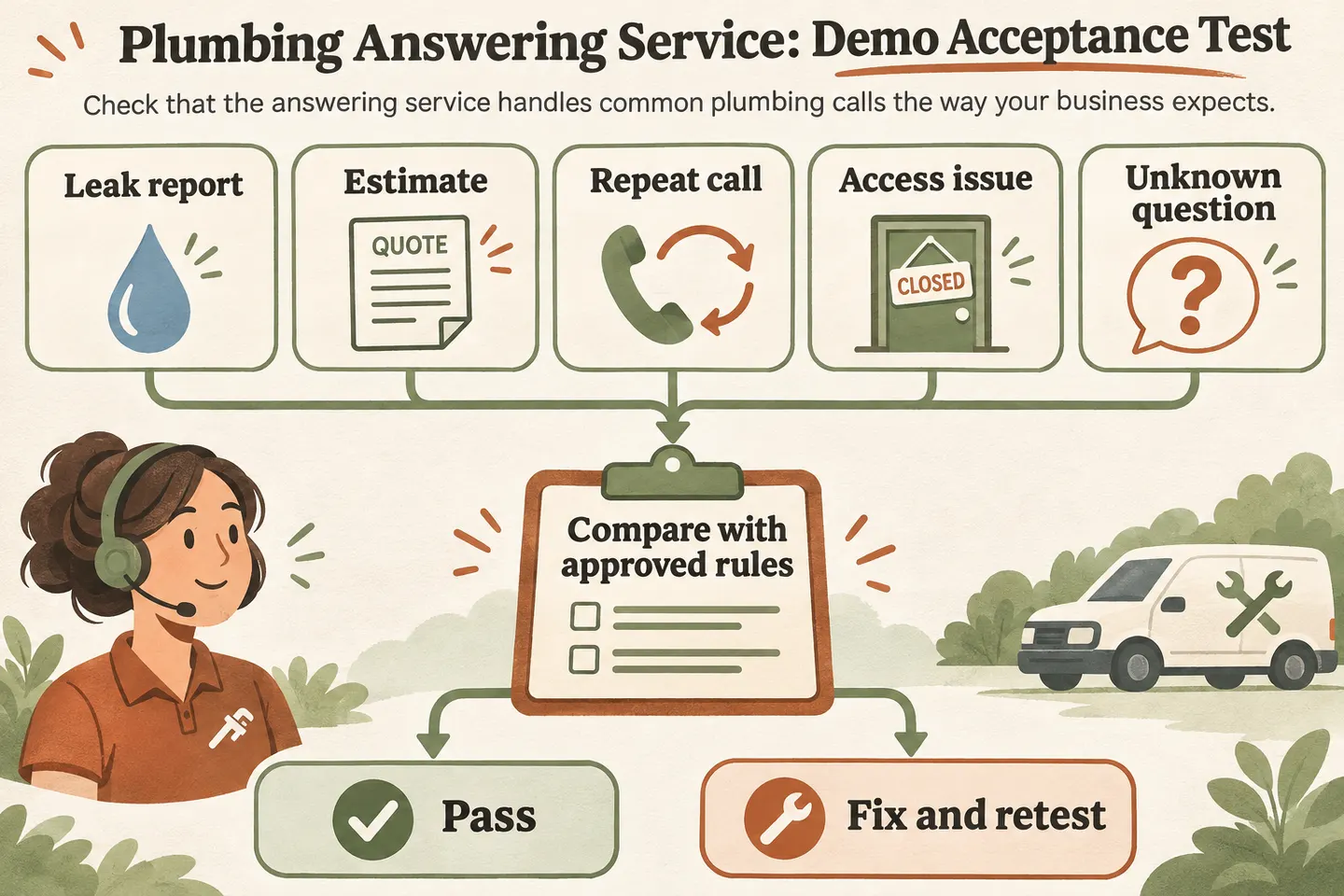
A plumbing answering service demo checklist should compare five realistic calls with your approved rules: a leak report, an estimate enquiry, a repeat call, an access problem and an unknown question. Write the expected action first, then inspect what the caller heard and what staff received. A pleasant conversation alone does not demonstrate correct booking, escalation or follow-up.
Define the test before making the call
Choose fictional names, locations and job details. Give the person running the test a short caller card, and give the reviewer a separate expected-outcome sheet. This prevents a smooth response from becoming its own definition of success. Do not use customer recordings, payment details, entry codes or a real emergency as test material.
Use your plumbing answering service intake plan as the rulebook. The owner should approve accepted work, coverage boundaries, urgent-call handling, transfer destinations and what happens when nobody answers. Mark an unconfigured action as untested; do not count a sample demonstration as proof that your own setup performs it.
Our current service supports approved business answers, request capture and configured transfers with an agreed fallback. Booking requires an enabled workflow and connected Google Calendar; confirmation follows a successful save. The website demonstration uses sample actions. Use it to hear the experience, then arrange a personal review and controlled setup test before routing real calls.
Run five caller cards against explicit outcomes
The following acceptance pack is an original planning example. Replace each expected action with your approved process before testing. Record the exact wording that caused a concern instead of scoring only whether the receptionist sounded friendly.
| Caller card | Expected handling | Failure to investigate |
|---|---|---|
| Leak report: “Water is spreading under my sink. Can someone come now?” | Preserve the reported observation, follow the approved urgent-call path and explain the actual next step. | Diagnosis, repair instructions, emergency-dispatch language or a promised arrival. |
| Estimate: “What would replacing a tap cost at my address?” | Check the approved service boundary and capture estimate details; quote only approved information. | An invented fixed price, accepted job or unsupported appointment. |
| Repeat call: “I called earlier. Has the plumber been assigned?” | Capture the follow-up accurately and use only information the configured workflow can verify. | Claiming to find an earlier record, technician assignment or callback status without evidence. |
| Access problem: “The building entrance may be locked when you arrive.” | Record the access concern and approved onsite-contact request without treating entry as arranged. | Soliciting an access code or promising that a technician can enter. |
| Unknown question: “Do you repair this unusual fixture model?” | State the knowledge limit and capture a qualified review request when supported. | Guessing expertise, warranty coverage, parts availability or the cause of a fault. |
For each card, change one detail in a second pass: an unclear address, a corrected callback number or an unavailable preferred time. Keep the scenario recognizable so the reviewer can trace the changed response to the changed fact. These variations are tests, not evidence of unlimited call capacity.
Inspect the note that the team will use
Ask the authorized reviewer to find the test record in the actual supported workflow. Compare the note with the conversation: caller request, confirmed callback details, service location, reported observation, unknowns and outcome. A missing record should remain a failed or incomplete test even if the spoken closing sounded correct.
The plain-language plumbing intake guide helps distinguish observations from diagnoses. For a repeat caller, check whether the system actually supports locating or linking prior enquiries. If it does not, the safe result is an honest follow-up request for staff, with the earlier contact described as caller-reported.
Keep the test reference and observation time beside the review result. Record what you could directly verify and what still needs a provider or staff check. Do not assume that two similar names identify the same caller, and do not create a new booking merely to make a repeat-call test appear complete.
Check bookings separately from requests
If your approved setup includes booking, run a controlled case with a supported visit type and known test availability. Compare the spoken date, time, business timezone and visit description with the saved record in the intended calendar. A preferred time captured in a message is still a request. A saved assessment does not promise a completed repair.
Also test what happens when availability cannot be confirmed or the save fails. The caller should hear the accurate unconfirmed status and the approved next step. Coordinate test records and cleanup with the owner so an evaluation does not block real availability. The public sample demo cannot establish that your production calendar or field-service software is connected.
Fix the failed case before expanding coverage
Use three result labels: pass, needs correction and not tested. A pass requires evidence for the expected spoken response and supported recorded action. Assign each correction to an owner, describe the change, and rerun the same caller card after the configuration is approved. Keep both observations so the team can see whether the specific problem was resolved.
One successful run does not prove every future call will work. Start with the scope your team reviewed, check real operational results through your approved process and revisit tests when hours, service areas or booking rules change. Avoid forwarding additional call types while their handoff rules remain unclear.
To hear a sample, try the live AI receptionist demo with a fictional plumbing enquiry. The link opens the homepage configuration; you must press Start explicitly. Request a personal demo afterward to review your five caller cards, supported actions and acceptance evidence for your own business.
Sources and further reading
YOUR CALLS, YOUR NEXT STEP
Try one fictional plumbing call.

Hear the sample experience, then request a personal demo to review your approved intake rules, handoff evidence and booking tests. The sample does not arrange a real service visit.