When a caller cannot name the plumbing problem: ask clearer questions
When a plumbing caller cannot describe the problem, ask about what they noticed, where they noticed it and what help they want. Keep their words, identify what remains unknown and read the summary back. The useful result is a clear request for the plumbing team, without requiring the caller to supply a technical diagnosis.
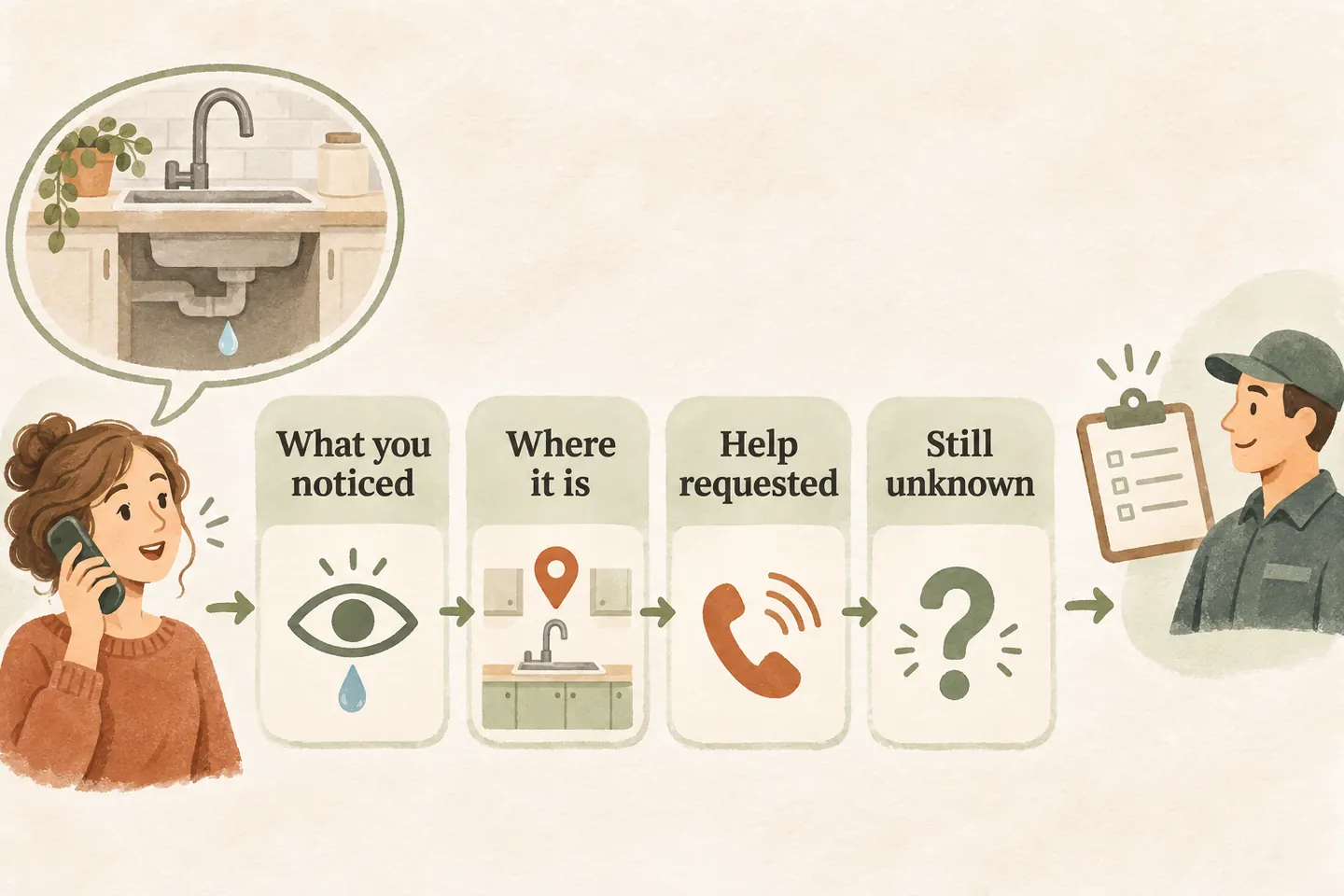
Start with the caller’s observations
Open with a question the caller can answer: “What have you noticed?” Give them room to describe it before offering categories. A caller may say “the thing under the sink” or “water near the washing machine.” Those phrases are useful starting points. Replacing them with a part name can make the message sound more certain than it is.
Your plumbing answering service needs enough information for the next approved action. It does not need to identify the failed component. Ask one follow-up at a time, using details the caller has already volunteered. If they cannot answer, record that gap and move on instead of repeating the question in more technical language.
Use a plain-language question bank
The following original worksheet is a starting point for owner review, not a diagnostic script or an instruction to inspect equipment. Select the questions that clarify the request. Do not read the whole table to every caller; stop once the receiving team has useful context.
| Purpose | Ask in ordinary words | Preserve in the note |
|---|---|---|
| Observation | What have you noticed? | The caller’s description, including their uncertainty. |
| Location | Which room or area are you talking about? | Room, floor or other location the caller can identify. |
| Nearby landmark | What is it near, if you already know? | A familiar landmark; no guessed component name. |
| Time noticed | When did you first notice it? | A reported time or approximate period, not an inferred start time. |
| Requested help | What would you like our team to help with? | The caller’s requested service or question. |
| Contact and next step | Which number should the team use to reach you? | Confirmed callback details and the approved next action. |
For example, “Which room is that in?” is enough when a caller says “the downstairs one.” Do not offer a list of possible faults for them to choose from. A location can remain incomplete: “Caller says downstairs bathroom; exact fixture unclear” is more useful than a confident but unsupported label.
Clarify location without asking the caller to investigate
Separate the service address from the location within the property. “At the shop” may identify neither. Confirm the address needed for coverage review, then ask which room or area the caller means. If they are calling on someone else’s behalf, note whether the description is secondhand.
Use a phone contact-details readback to check the callback number and service location. Keep that verification separate from identifying the plumbing issue. A confirmed address does not confirm service coverage, a booking or the source of the reported problem.
Do not ask the caller to remove a cover, operate a valve, reproduce a sound, test a fixture or move closer to inspect something. This question bank uses information they already have. Technical or safety-sensitive questions belong with the approved qualified contact; the receptionist should not decide that a situation is harmless.
Preserve uncertainty in the handoff
Use separate fields for reported observation, requested help and unknowns. Mark “caller unsure” when that is what the caller said, and “not established” when the call did not establish a fact. These are different from “none.” Avoid writing “no leak” merely because the caller could not identify one.
These are invented practice examples, not customer records or evidence of a configured product action. Keep access codes, payment information and unrelated personal details out of practice calls. The receiving plumber can ask follow-up questions within the business’s own process.
Confirm the summary and the actual next step
Read back the useful facts before closing: “You noticed a wet patch under the kitchen sink, the source is unclear, and you want a callback about a visit. Have I understood that correctly?” Let the caller correct both the description and their requested help. A correction should replace the inaccurate detail, not sit beside it as a competing version.
Then describe only the action actually taken. A captured request is not an accepted job. A transfer attempt does not establish that a person answered. Use the owner-approved urgent-call and unanswered-transfer rules when applicable, without inventing an arrival time, providing repair directions or presenting this intake process as emergency assistance.
Review the questions with the plumbing team
When evaluating an AI receptionist for small business, check whether its approved questions preserve the distinction between observations and conclusions. Our current service supports approved business answers, request capture and configured handoffs. The question bank here is a proposed script for review, not a promise that every workflow is already enabled.
Have the receiving team review fictional notes for accurate observations, useful location details, visible unknowns and an honest outcome. Then try the live AI receptionist demo with a nonsensitive example. The link opens the existing setup; press Start when ready. The sample does not arrange a real visit. Request a personal demo to review your approved questions and handoff rules.
Sources and further reading
YOUR CALLS, YOUR NEXT STEP
Try a fictional plumbing enquiry.

Hear how the sample handles an unclear description, then request a personal demo to review your approved questions and next steps. Press Start explicitly; the website demonstration does not book a real visit.