Plan what happens when a caller asks for language help
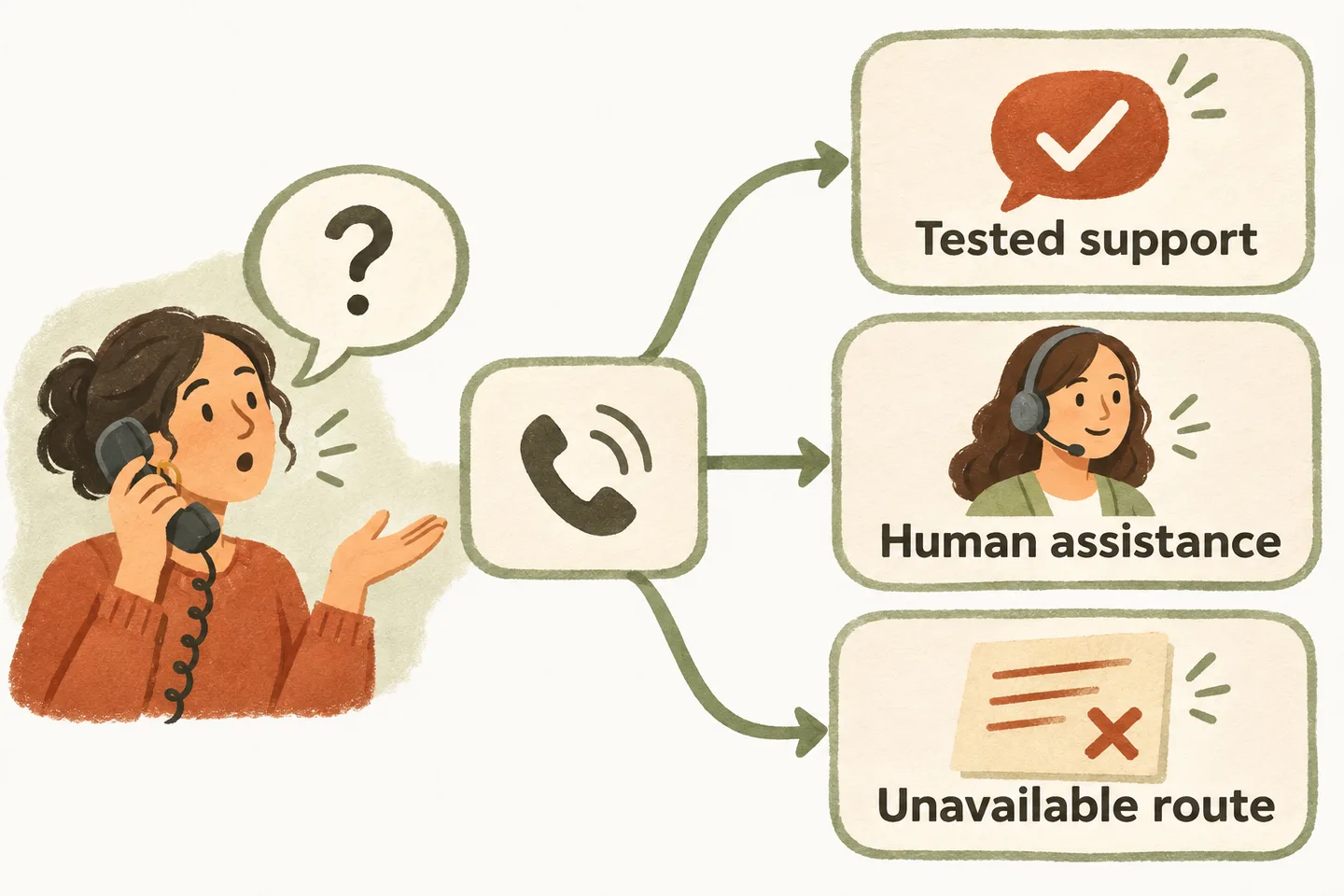
A business phone interpreter request policy should identify which language needs your business can actually handle, who can provide approved human help, and what to say when no supported route exists. Test the proposed conversation and handoff before advertising them. A request for language assistance does not prove that an interpreter is available or that the caller understood the next step.
Start with the languages your callers actually request
Ask the owner and frontline staff which language requests they have encountered, what the caller needed, and where communication became difficult. Keep aggregate planning notes where possible. A name, accent or address is not a reliable substitute for asking the caller’s preference. Population statistics also cannot establish an individual caller’s needs.
Separate the request from your proposed response. “Caller asked for help in French” is an observed need; “we can complete appointment changes in French” is a capability that still needs evidence. Note whether the task involves basic opening hours, a detailed service enquiry or an action requiring exact confirmation.
When evaluating an AI receptionist for small business record these needs alongside the approved services, hours and handling instructions. This guide proposes an owner-reviewed operating policy; it does not add language support or an interpreter service to the product.
Test the complete task before making a language claim
Have a competent reviewer of the requested language evaluate fictional calls in the intended configuration. Check whether the spoken answer, captured details and next step preserve the same meaning. Include ordinary phrasing, a correction and a request outside the permitted task. A greeting that sounds fluent does not demonstrate reliable handling of addresses, dates or service restrictions.
Record the configuration, language, task, test date, reviewer and observed result. A passing result should name its narrow scope; a failed or unreviewed case stays unsupported for that policy. Test the fallback as carefully as the happy path, including an unavailable staff member. Do not present a suggested test as one already completed.
Our public offer describes approved business knowledge, request capture and transfers to an approved destination with an agreed fallback. Those features do not establish that a particular language, interpreter connection or complex conversation has been tested for your business.
Use one decision table for each approved route
Complete this original table with the owner before enabling a route. Each row describes a condition to verify, not an existing product capability. Put the approver, review date and actual contact arrangement beside your completed copy.
| Situation | Evidence needed | Permitted next step |
|---|---|---|
| Requested language and task are supported | Reviewed test results for this configuration and task. | Continue within the approved scope; check important details. |
| Approved human help is available now | Named role, language ability, reachable destination and tested handoff. | Explain the proposed handoff and follow the approved connection process. |
| Approved human help is available later | Staff owner and an agreed contact process; no immediate availability. | Offer only the approved later-contact option, without promising a time that is not agreed. |
| No supported route is available | Requested language or task is untested, failed or has no approved assistance. | State the limitation clearly and offer only a verified alternative. |
If the evidence column is blank, do not move the caller into a supported branch by assumption. Record the unresolved need for owner review without collecting an unnecessary account of the caller’s personal circumstances.
Confirm what human assistance actually means
A colleague who can discuss routine services is not automatically a qualified interpreter for every subject. Define the person’s role, permitted topics, working hours and backup. Check how the caller reaches that person and what happens if nobody answers. Availability on a staff list does not mean availability during this call.
If separate assistance is proposed, use these answering-service extra-charge questions to establish who supplies it, whether the connection is supported, which charges apply and who approves them. Do not describe a third-party interpreter as included in a plan without a specific agreement.
Document handoff outcomes precisely: connection attempted, person reached, later contact requested or no route available. A transfer attempt is not proof that help was delivered. Avoid promising an automatic callback merely because a message has been captured.
Use clear wording when the requested help is unavailable
Use an alternative only when it exists and the caller can understand the offer. If an approved staff contact can help later, explain that limitation before requesting contact details. Say a request was recorded only after successful capture. If understanding remains uncertain, do not treat silence or a vague response as agreement.
For example, a fictional salon has an approved staff contact for routine enquiries later in the day, but no immediate language-help route. The receptionist may offer the agreed later-contact process. It must not invent an interpreter, confirm a service change or promise that someone will call at a particular time.
Review third-party access before using it
Before adding outside assistance, establish who will hear the conversation, what information may be shared, whether records are created and who can access them. Have the appropriate adviser review the disclosure and consent process for your business and location. An improvised phone script cannot settle those requirements.
For Canadian businesses, the privacy commissioner’s meaningful-consent guidance emphasizes explaining what information is collected, with whom it is shared and why. Its application depends on the rules governing the organization; it does not certify any interpreter arrangement or establish US requirements.
Use the AI receptionist privacy questions to collect written answers before approving a setup. Recheck the policy when staff availability, providers or supported tasks change.
You can try the live AI receptionist demo with fictional, nonsensitive details. The link opens the homepage configuration; press Start when ready. The sample is not a verified interpreter service. Request a personal demo to review your language needs and proposed handoff before production approval.
Sources and further reading
YOUR CALLS, YOUR NEXT STEP
Review your language-help policy in a personal demo.

Try the live sample with fictional details, then request a personal demonstration to check your approved tasks and human handoff. The sample does not establish interpreter availability.