Design a missed-call coverage experiment you can measure
Choose your missed call answering service pilot metrics before changing call routing. Compare equivalent business hours, use the same counting rules in both periods and keep unknown outcomes visible. Define a qualified enquiry and completed follow-up separately. The result should support a bounded decision about the next test, without treating a small before-and-after comparison as proof of extra revenue.
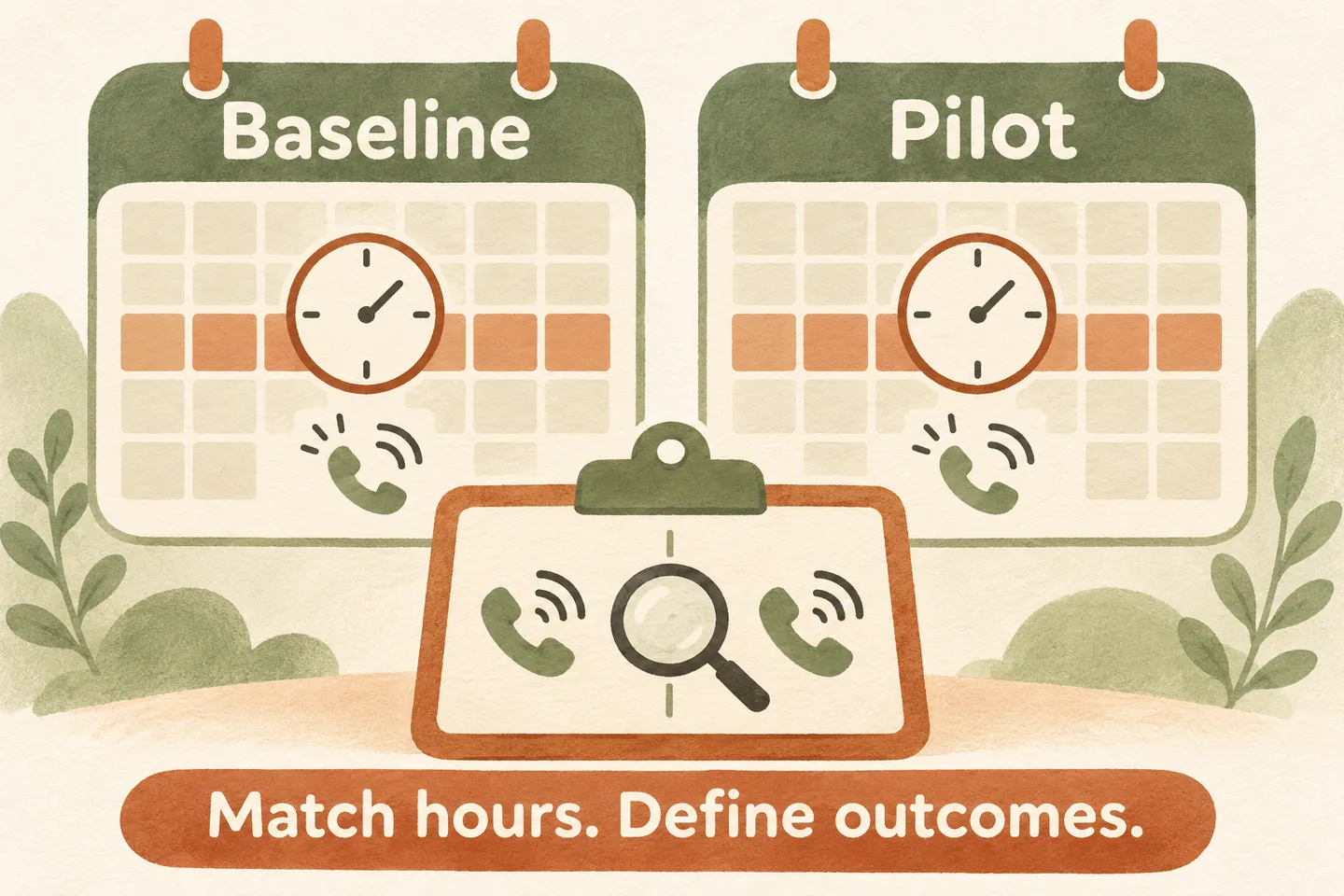
Choose one coverage question
Start with a decision the business can act on: “During our weekday lunch window, does the proposed coverage produce usable next steps while keeping staff follow-up manageable?” Name the hours, call types, responsible owner and maximum approved spend. A test that changes hours, staffing, advertising and booking rules together will be harder to interpret.
Map the permitted outcomes in your AI receptionist call flow first. For this pilot, a usable next step might mean an approved answer, a successfully saved booking, a confirmed handoff or an actionable captured request. Record the evidence required for each; sounding helpful is not enough.
Our AI receptionist for small business offer describes approved answers, request capture and configured transfers with an agreed fallback. Booking requires an enabled workflow and connected Google Calendar. This measurement plan is a manual business review, not a claim that the product runs controlled experiments or calculates these measures automatically.
Match the baseline and pilot windows
Write both date ranges, local times and timezone before collecting results. Compare the same weekdays and hours where practical: for example, two ordinary Monday-to-Friday lunch periods before a change and two afterward. The duration is an illustrative starting point, not a statistically sufficient sample or a universal recommendation.
Keep the service area, offered services and staff callback arrangement comparable. Log holidays, severe weather, promotions, seasonal demand, staffing changes and carrier incidents. Record the call mix: new enquiries, existing customers, suppliers, sales calls, wrong numbers and unknown purpose. Do not silently classify an unanswered call as an unqualified enquiry.
Use the same available business-line call history in both periods. A list containing only calls that reached the new receptionist omits earlier routing failures and cannot establish total demand. If baseline records cannot support the proposed measure, collect a better baseline or narrow the conclusion instead of inventing missing outcomes.
Copy this baseline-versus-pilot plan
Complete one shared definition sheet before the pilot. Keep identifying caller details in the appropriate restricted records; the comparison can use references and totals. Retain separate columns for baseline, pilot, evidence gaps and reviewer. These proposed definitions need the owner’s approval.
| Measure | Definition and counting rule |
|---|---|
| Calls in scope | All recorded incoming calls within the agreed hours. Keep repeat calls as calls; link them to an enquiry reference rather than counting every call as a new prospect. |
| Usable next step | Calls with evidence of one approved answer, saved booking, confirmed handoff or actionable request, divided by all in-scope calls. Count each call once; mark missing evidence unknown. |
| Qualified enquiry | One distinct request meeting your prewritten service, geography and customer-fit rules. Separate confirmed fit, not fit and unknown; qualification does not mean a sale. |
| Follow-up completed | Among qualified enquiries requiring follow-up whose review deadline has passed, the share reaching the agreed documented resolution. Track attempted contact and pending work separately. |
| Workload and exceptions | Staff review minutes, unresolved requests, unsupported promises and failed actions. Record the evidence and owner; do not offset a serious exception with a higher call total. |
Set the follow-up observation period in advance and give both groups equal time to mature. For example, comparing five-day-old baseline enquiries with yesterday’s pilot enquiries would leave different opportunities for resolution. Define what “completed” means for your workflow: a documented answer or agreed disposition, not merely an attempted callback.
Separate observations from causal claims
Report counts beside percentages. A different mix of easy questions, more complete pilot records or increased staff availability could help explain a change. Preserve unknowns in the report. Better documentation is useful, but it must not be mistaken for a proven improvement in the underlying customer outcome.
NIST’s experimental-design guidance explains that design choice depends on the objective and factors being investigated. This practical before-and-after worksheet is descriptive. If you need a causal or statistically reliable estimate, obtain qualified experimental-design advice before selecting the comparison and sample.
Agree the next decision before seeing results
Write three possible decisions: expand the same supported workflow, revise one weakness and repeat, or stop. Assign the reviewer and date. Require adequate records, manageable follow-up workload and no unresolved serious exceptions before considering wider coverage. Choose any numerical threshold with the owner; this guide does not supply an evidence-based success target.
Keep cost interpretation separate. Use the missed call cost calculator small business worksheet to examine contribution assumptions after you have credible enquiry outcomes. A captured request is neither collected revenue nor a completed job, and a free demonstration is not a production trial.
To explore the conversation first, try the live AI receptionist demo with fictional, nonsensitive details. The link opens the homepage configuration; press Start when ready. Request a personal demo to check your proposed scope, supported records and human responsibilities before activating real call coverage.
Sources and further reading
YOUR CALLS, YOUR NEXT STEP
Explore a call before designing your pilot.

Try a fictional enquiry, then request a personal demo to verify the coverage window, supported actions, available records and staff follow-up responsibilities.