Capture an HVAC service complaint for the right human follow-up
HVAC service complaint intake should preserve what the caller reports, identify the visit they mean and record the resolution they want. Keep those three items separate. An intake conversation can acknowledge a concern and prepare a useful human follow-up; it should not decide fault, approve a refund, confirm warranty coverage or promise a return visit.
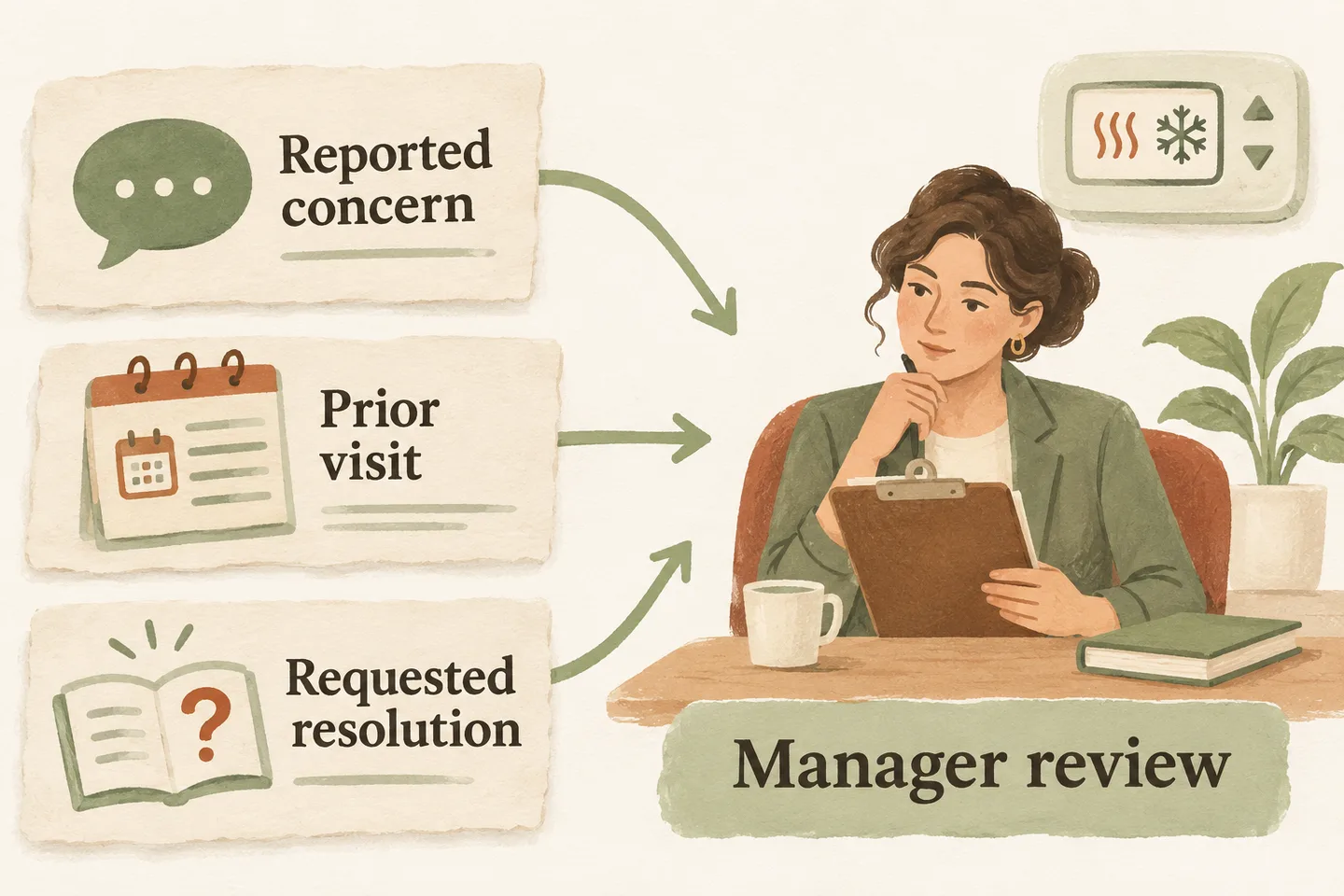
Define who may decide the outcome
Before routing complaints to a receptionist, name the reviewing manager. Agree which facts to collect, when to offer an approved transfer and what happens if nobody answers. Recording a complaint does not resolve it, and the person taking the call should not negotiate an unauthorized remedy.
The HVAC answering service guide separates repair, maintenance, estimate and account calls. Add a complaint path for disputes about earlier experiences. Preserve any new service need alongside the complaint instead of converting everything into a fresh appointment.
Our AI receptionist for small business can capture caller details and requests, answer from approved information and use configured transfers with an agreed fallback. That does not establish automatic access to service records, invoice disputes or warranty decisions. Verify the actual supported workflow before assigning any of those actions.
Use a form that separates reports from decisions
This original form supports manual staff review. Adapt its fields to your approved workflow; it does not represent a product screen or automated complaint queue. Collect only what the review needs, excluding payment-card details, passwords and building access codes.
| Field | What to record | Boundary |
|---|---|---|
| Contact and location | Caller name, callback number and relevant service address; read back uncertain details. | Contact details do not prove authority to see or change an account. |
| Prior visit reference | Date or approximate period, reference supplied by the caller and the service they describe. | A missing reference is not proof that no visit occurred. |
| Reported concern | What the caller says happened, in plain language, including anything they cannot confirm. | Do not turn a report into a diagnosis or a finding against staff. |
| Sequence | What the caller says occurred before and after the visit, without adding a cause. | Timing alone does not establish that the visit caused the concern. |
| Requested resolution | A manager conversation, explanation, refund review or possible return visit, as requested. | A request is not approval, entitlement or a confirmed booking. |
| Current concern | Any separately reported present issue, handled under the approved safety and service boundaries. | Do not assess whether equipment or a situation is safe. |
| Follow-up ownership | Designated reviewer, fallback and any approved caller-facing expectation. | Do not invent a deadline, assignment or successful transfer. |
Keep approximate dates uncertain. “Caller thinks the visit was last Tuesday” is better than a guessed date. Staff can reconcile the reference through their authorized process while preserving the caller’s original account.
Acknowledge the concern without deciding fault
A neutral opening can be warm: “I am sorry this has been frustrating. I can record your concern and the response you would like, then follow the approved route to the right person.” Have the business review this wording; it promises no particular outcome.
After capture succeeds, read back the core distinction: “You would like the manager to review the concern and discuss whether another visit is appropriate. I have recorded that request; a visit and its terms are not confirmed.” Let the caller correct the description. Avoid adding labels such as careless technician, defective part or invalid complaint.
Keep safety questions and remedy decisions within bounds
If a complaint includes a current safety concern, follow the business’s preapproved referral wording and human handoff rule. Intake must not become troubleshooting, medical assessment or reassurance that continued equipment use is safe. A complaint callback is not emergency dispatch. Review this boundary before activation, rather than inventing an instruction during a difficult call.
Use the HVAC troubleshooting boundaries to separate approved business facts from technical questions requiring qualified review. The receptionist can preserve the caller’s account without asking them to inspect, adjust or diagnose equipment.
For refunds, warranty questions and repeat visits, record the requested decision and who may make it. Do not infer coverage from an installation date, maintenance-plan claim or previous payment. Even an available calendar time does not establish that a return visit is authorized or free.
Give the manager a usable handoff and an honest status
The reviewer needs the reported concern, prior-visit reference, requested resolution, confirmed contact details and remaining unknowns together. If the approved transfer is unanswered, use its agreed fallback. Tell the caller what actually happened: a request was captured, a transfer was attempted or the conversation reached a person. Do not say the manager accepted the case unless that is confirmed.
Use a staff-owned review log to track the next owner, promised contact window if one was approved, actual contact attempt and current outcome. These are suggested operating fields, not claimed automatic product features. A message left for the caller is not the same as reaching them, and a discussion does not necessarily mean the complaint is closed.
Before closing the record, the manager should document the decision communicated and anything outstanding. Keep the original report distinguishable from later findings. Use recurring misunderstandings to improve visit-scope wording, without treating a small set of complaints as a reliable performance rate.
Test the whole path with a fictional complaint
Run a fictional case with an uncertain visit date, a requested refund and an unanswered manager transfer. Check the saved note, spoken next step and staff follow-up ownership. Correct any unsupported promise before using the flow with real callers. The exercise tests intake quality; it does not prove that the underlying service dispute can be resolved automatically.
You can try the live AI receptionist demo with nonsensitive fictional details. The link opens the homepage configuration; press Start explicitly to begin. Its sample actions do not resolve a real complaint. Request a personal demo to review your approved manager handoff and the records your actual setup supports.
Sources and further reading
YOUR CALLS, YOUR NEXT STEP
Try a fictional complaint handoff.

Hear the sample experience, then request a personal demo to review approved wording, manager ownership and supported records. No refund, warranty decision or repeat visit is implied.