Set clear boundaries for HVAC troubleshooting questions on the phone
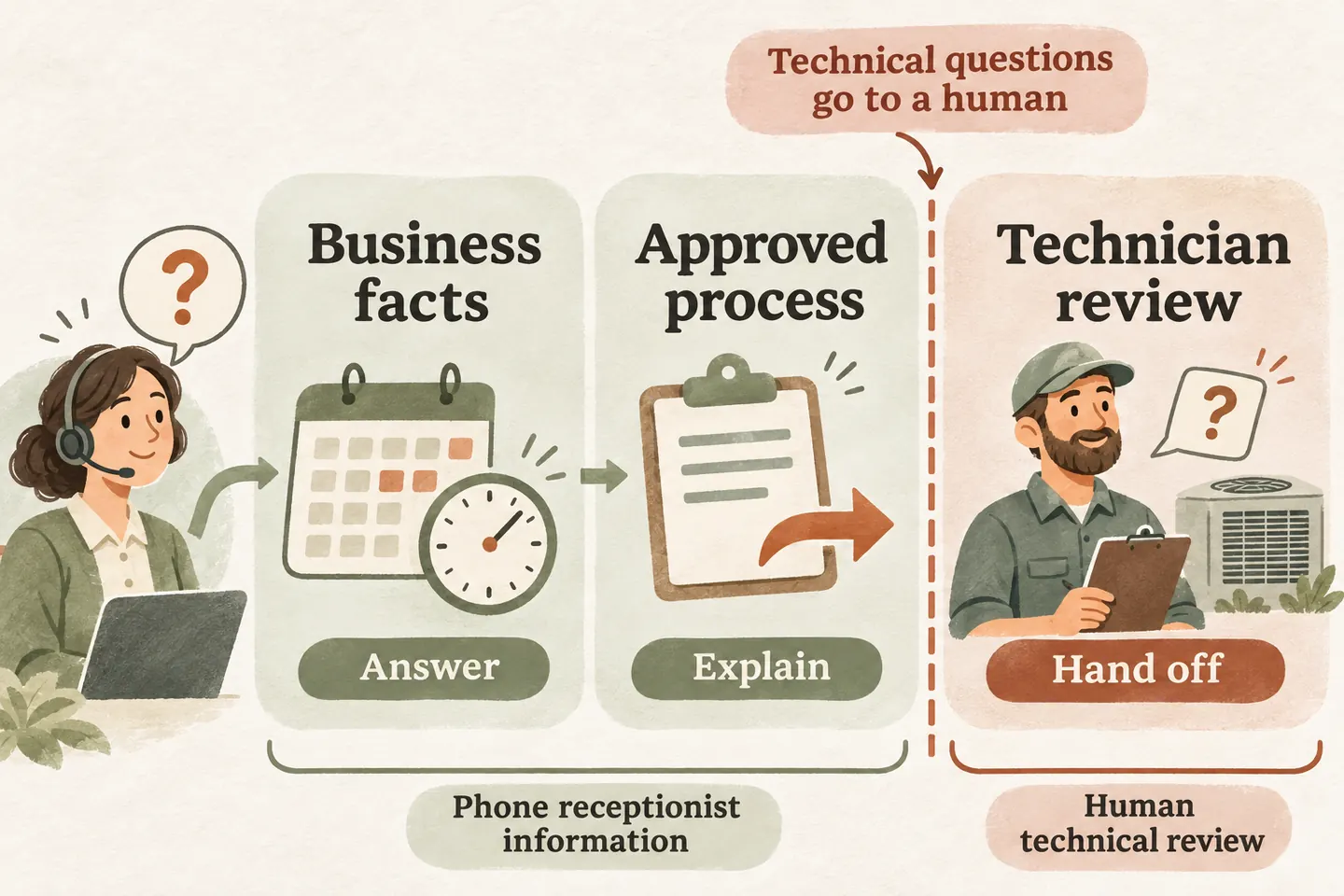
Set HVAC receptionist troubleshooting boundaries by separating approved business facts from equipment judgments. A receptionist can explain your documented service process, capture what the caller noticed and arrange the approved next step. Diagnosis, repair instructions and assurances that equipment is safe belong outside that role. Give every unanswered technical question a named human owner.
Approve answers by question, not by familiar wording
An HVAC answering service needs a more precise rule than “answer common questions.” A familiar question can still require technical judgment. “Do you service heat pumps?” concerns your service list. “Is this heat pump noise normal?” asks someone to assess a particular system. Similar vocabulary does not make both answers suitable for reception.
For each approved answer, record its source, responsible owner and review date. The source might be your current hours, service-area policy or documented visit process. If the answer changes by equipment, site conditions or a technician’s assessment, keep those qualifications visible. Do not turn a general brochure into permission to recommend a repair.
Use the approved-answer knowledge base template to maintain those sources. This guide adds the question-level boundary: what can be said, what remains unknown and who takes over.
Use a three-category approved-answer matrix
The following matrix is an original planning artifact. Its questions are hypothetical, and its owner roles are suggestions for your business to assign. It describes a review policy; it does not assert that software automatically classifies every caller correctly.
| Question type | Example question | Permitted response | Boundary and owner |
|---|---|---|---|
| Business facts | “Do you serve my neighbourhood?” | Read the current approved service-area rule; capture an uncertain location for review. | Do not assume coverage. Office owner resolves exceptions. |
| Business facts | “What time does the office open?” | Give the approved hours, including any recorded holiday exception. | Do not infer technician availability from office hours. |
| General process | “What happens after I request a visit?” | Explain the documented review or booking process and its actual next step. | A request is not an accepted job or arrival promise. Service coordinator owns follow-up. |
| General process | “Does a maintenance visit include this repair?” | State only the approved scope; identify the part needing confirmation. | Do not infer coverage or final price. Office or service lead reviews. |
| Technician-only advice | “What does this noise mean?” | Record the caller’s description and use the approved technical handoff. | Do not diagnose, suggest a component or give repair steps. Qualified technical owner reviews. |
| Safety-sensitive advice | “Can I keep using it?” | Do not assess safety; use the business’s separately reviewed safety-response wording. | No reassurance, troubleshooting or routine callback substitute for an emergency response. |
A conversation can move between categories. Answering the opening-hours question does not authorize the next answer about an unusual smell. Apply the boundary to each new question.
Give an honest unknown-answer response
Use a short acknowledgment, a clear limit and an available next step. An original example is: “I can explain our visit process, but I cannot determine what is causing that problem. I can record what you noticed and ask the service team to review it.”
If a transfer is configured and appropriate, offer it without promising an answer. If nobody answers, describe the agreed fallback accurately. Do not add “probably,” name a likely fault or promise that someone will call within an invented window. An uncertain technical answer stays uncertain even when the caller presses for reassurance.
Keep safety-sensitive questions out of troubleshooting
Do not ask the caller to perform tests, open equipment or change settings to prove that a reported concern is harmless. Do not classify a concern as safe because the description sounds minor. Your technical owner should approve a separate response for reported hazards, including suitable emergency or utility directions for your operating area.
For background, the US Environmental Protection Agency lists furnaces among possible carbon monoxide sources. That fact does not let a receptionist identify an exposure or assess a system by telephone. A routine service message must not be presented as emergency assistance.
Keep the concern intact in the handoff note
Separate what the caller said from actions the receptionist actually completed. Record the callback details, service location, question, approved response given, unresolved point and next owner. Ask only for information needed for that next step. Preserve uncertainty rather than substituting a technical label.
Avoid changing that note to “faulty motor” or “safe to wait.” Neither conclusion came from a qualified assessment. If a transfer was only offered, record “offered,” not “completed.”
Review new questions with the technical owner
Keep a small review list of questions that fell outside approved content. The technical owner decides whether each deserves a documented business answer, clearer process wording or a permanent technical-only boundary. Repeated questions are evidence of a review need, not permission to automate advice.
Test paired fictional questions before widening coverage: a service-list question followed by a diagnosis request, a visit-process question followed by a safety question, and an unanswered transfer. Check both the spoken response and the saved note. Revise any answer that invents certainty, drops the caller’s concern or implies a completed handoff.
Try the boundary with a fictional call
The current AI receptionist for small business offer includes approved answers, request capture and configured human transfers with an agreed fallback. Those features do not establish technical competence or emergency dispatch. Verify your actual question policy and receiving team during setup.
You can try the live AI receptionist demo with a fictional, nonsensitive enquiry. Opening the panel does not begin a call; press Start when ready. The sample does not diagnose equipment or prove your production handoff. Request a personal demo to review the boundaries your HVAC team needs.
Sources and further reading
YOUR CALLS, YOUR NEXT STEP
Test what the receptionist should leave to your team.

Try a fictional business question followed by a technical question. Request a personal demo to review approved responses, the human handoff and the limits of your actual setup.