AI receptionist for cleaning businesses: turn enquiries into clear quote requests
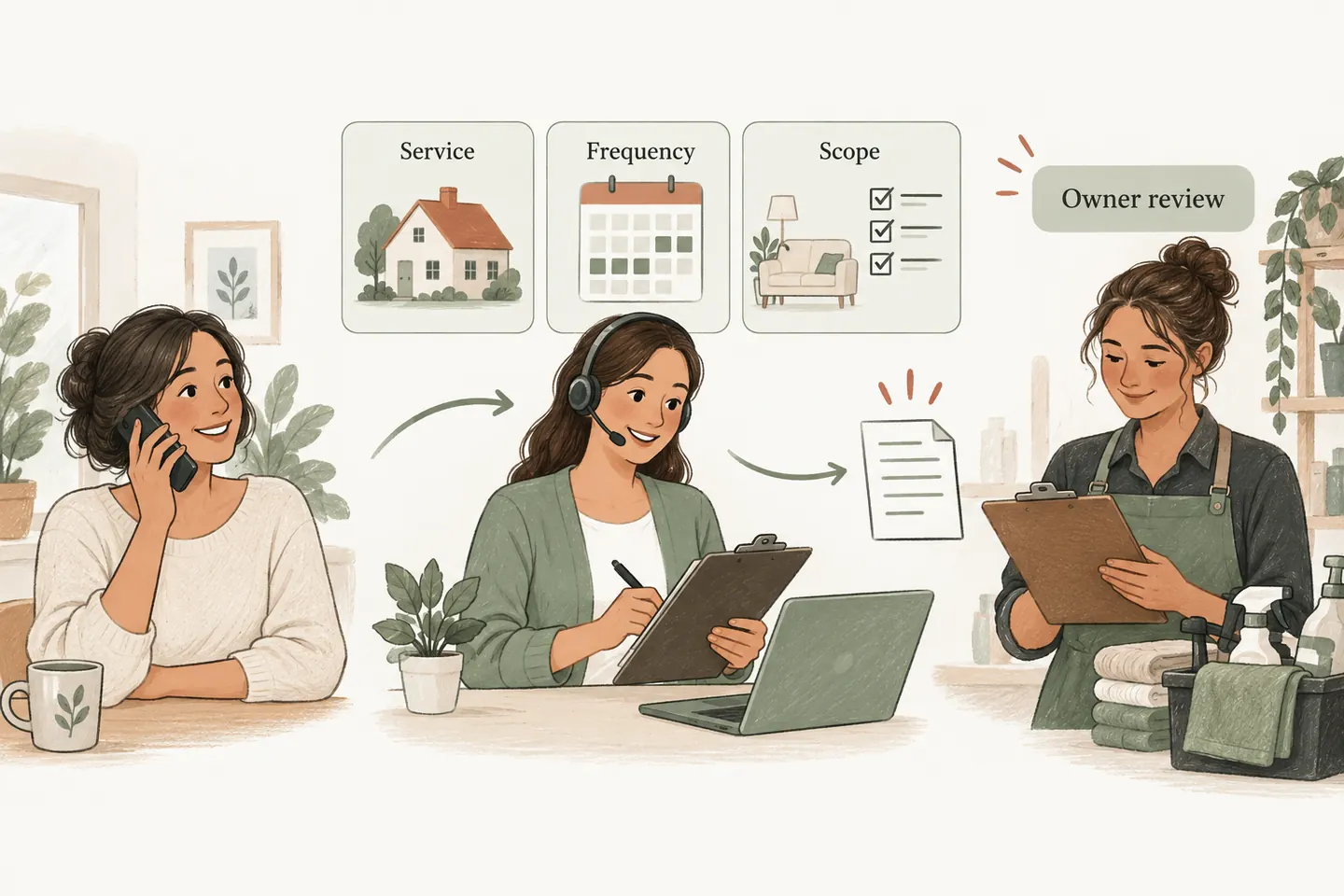
An AI receptionist for a cleaning business should help your team understand the enquiry before anyone promises a price or a cleaning slot. Start with service type, frequency, location and the caller’s priorities, then give the request a clear owner. This guide provides an original intake worksheet and a fictional example you can adapt for your own approved services.
Updated
Define the job the phone conversation should do
When you are cleaning a property, supervising a team or travelling between visits, a new enquiry can arrive before you are ready to discuss it. A useful first conversation gathers enough context for the next person to respond. It does not need to reproduce your entire estimating process or ask the caller to complete a long questionnaire.
Choose one initial outcome: a quote request, a consultation request or an eligible appointment. Our AI receptionist overview describes approved answers, caller-detail capture and configured next steps. Decide which of those outcomes fits your cleaning operation before connecting calls. A company offering residential maintenance cleaning may need a different intake from one quoting commercial contracts.
Capture scope before discussing a price
A caller’s description of a “standard clean” may differ from your service definition. ISSA’s workloading fact sheet explains that cleaning time depends on several factors, including the space, work scope, equipment and expected standard; floor area alone does not describe the whole job. That supports a practical intake rule: record the requested work and let your approved estimating process determine the commitment.
Keep a short, owner-approved service list beside the intake instructions. Separate routine visits from first-time, move-out or other work only if your business actually offers those categories. If the caller requests something outside that list, record the request for review. Do not silently treat it as included, promise that every stain will be removed, or give an unsupported time estimate.
Use a cleaning quote-request worksheet
The worksheet below is an original planning example, not a mandatory script. Start with the questions that change your next action. Let callers explain their request naturally, then fill the gaps. If a field will not help your team decide service fit or arrange follow-up, remove it.
| Field | Useful prompt | What staff should receive |
|---|---|---|
| Service category | Is this a routine visit, a first clean or another service? | Caller’s description and the closest approved category. |
| Property and area | What kind of property is it, and which area is it in? | Property type and enough location detail to check coverage. |
| Frequency | Is this one visit or ongoing cleaning? | Requested frequency; no recurring schedule promised. |
| Scope and priorities | Which rooms or tasks matter most for this request? | Requested tasks, exclusions and any uncertainty. |
| Timing | When would you like the work considered? | Preferred date or window, clearly marked as a request. |
| Follow-up | What number should the team use to reach you? | Confirmed callback details and an assigned reviewer. |
Ask about pets, occupancy or access arrangements only when relevant to your actual service policy. At this stage, a note such as “someone must meet the cleaner” may be sufficient. Do not collect alarm codes, door passwords, payment-card details or a catalogue of valuables in a general quote conversation. Arrange any necessary sensitive exchange through the business’s approved process.
Turn a vague enquiry into an actionable request
Consider a fictional caller asking for a three-bedroom home to be cleaned before visitors arrive. They also mention inside the oven and hope to continue every two weeks. A weak summary says only “house cleaning, Thursday.” A useful summary separates the first visit, the extra task, the deadline and the possible ongoing arrangement.
The owner can now respond to a specific request. The receptionist has not assumed that oven cleaning is included, that a recurring discount exists, or that the team can finish before the visitors arrive. Those decisions remain with the approved service and estimating rules.
Keep a quote request separate from a confirmed visit
If the next step is a staff callback, say so plainly: “I’ve recorded what you need, and the team will review the request.” Give a response window only if the team has agreed it can meet that window. A caller who asks for tomorrow should hear whether tomorrow is merely a preference or a successfully saved appointment.
With AI Receptionists, production booking requires an approved configuration, an enabled workflow and a connected supported Google Calendar. That does not establish compatibility with a cleaning dispatch platform, route planner or recurring-service system. Verify the exact connection before relying on it. Even a saved consultation appointment does not automatically reserve a cleaning crew or approve a quote.
Use the four-outcome call-flow guide to map the difference between answering a question, attempting a transfer, saving an eligible booking and taking a request. Assign a fallback when the requested action cannot complete.
Test the workflow with realistic cleaning enquiries
- An ordinary enquiry: the service and area fit, but the caller has not chosen a date. Does the summary preserve what needs deciding?
- A scope change: the caller adds an unapproved task after discussing routine cleaning. Is it clearly flagged for review?
- An unavailable date: the preferred day cannot be confirmed. Does the receptionist avoid saying the visit is booked?
- An existing client: the caller wants to change an arrangement. Does the flow follow your verification and staff-review policy?
Use fictional details for these tests. Review the request your team would receive, not just whether the voice sounds pleasant. Start with one bounded call type, check real outcomes after activation and revise confusing questions before expanding the workflow.
You can try the live AI receptionist demo with a fictional cleaning enquiry. The demonstration uses sample actions; use a personal setup discussion to verify your services, calendar requirements and human follow-up process.
Sources and further reading
YOUR CALLS, YOUR NEXT STEP
Try a cleaning enquiry in the live demo.

Use a fictional service request and listen for a clear next step. Production services, booking and staff follow-up must be agreed during setup.